


 简体中文
 Japanese
 Korean
 Russian
 繁体中文
 Español
Valve selection
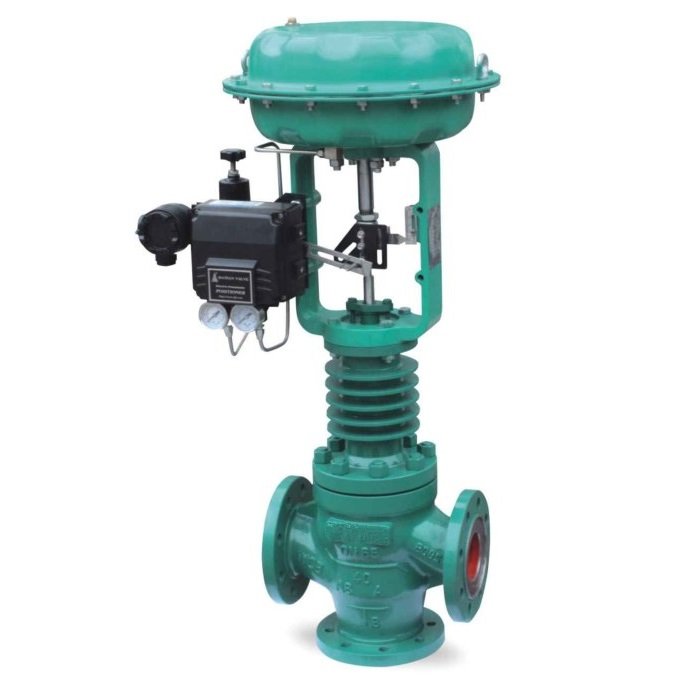
Diaphragm Pneumatic Three-Way Control Valve Split/Combine
| Specification | Value |
|---|---|
| Model number | ZJST |
| Specification and caliber | DN40-DN600 |
| Pressure level | PN16/CLASS 150/10K |
| Material | WCB Cast Steel/304 Stainless Steel, CF8/316L, CF8M |
| Product Features | Three-way, Pneumatic Control |
The diaphragm pneumatic three-way control valve is an industrial valve driven by a pneumatic actuator to achieve media splitting or combining control. The actuator responds quickly and has high control accuracy, compatible with standard signal inputs such as 4-20mA and 0.2-1.0bar, supporting seamless integration with PLC/DCS systems for automated regulation.
This valve is suitable for flow distribution, temperature regulation, and pressure balancing of liquids, gases, and steam, commonly found in heat exchange systems, temperature control of reaction vessels, and energy distribution fields. Its core employs a three-way flow path design, changing the media flow direction through valve core displacement, meeting the process requirements of "one inlet and two outlets" or "two inlets and one outlet", with flexible control and energy-saving characteristics.
The valve adopts a diaphragm pneumatic actuator, utilizing compressed air to drive the diaphragm to generate thrust, controlling the valve rod movement through spring return or double-acting mode. The valve body material can be selected from CF8 (304), CF8M (316) stainless steel, or carbon steel, with internal components hardened or overlay welded with Stellite alloy to enhance erosion resistance and cavitation resistance, suitable for high temperature, high pressure, or corrosive media environments.
The valve core structure adopts a balanced design, effectively reducing the impact of fluid unbalanced forces on the actuator thrust, ensuring the stability of the valve under high differential pressure conditions. The three-way flow path is optimized through fluid dynamics to reduce turbulence and pressure loss, minimizing the impact of the media on the valve internals. The sealing surface uses metal hard sealing or soft sealing (such as PTFE, graphite composite materials), with leakage levels meeting ANSI Class IV and above standards, maintaining reliable sealing performance even under high-temperature conditions.
In application scenarios, this valve can accurately control the mixing ratio of hot and cold media in heat exchangers, adjust the temperature of reaction vessels, or balance the pressure in pipeline systems. For example, in district heating systems, it achieves thermal energy distribution by adjusting the flow of hot water on the primary and secondary sides; in chemical production, it coordinates the mixing ratio of two reactants to optimize reaction efficiency. Its modular structure design simplifies maintenance processes, allowing for quick replacement of wear parts such as valve seats and cores, reducing downtime.
Additionally, users can select explosion-proof actuators, high-temperature packing, or corrosion-resistant coatings based on operational requirements, suitable for a temperature range of -40â to 450â. The valve complies with ISO, GB, API, and other standards, balancing control accuracy with long-term operational reliability, providing efficient and flexible fluid control solutions for complex conditions in process industries.
Selection and Usage Information
Confirm the port functions, two-way flow, and system balance together, and refer to three-way combining and system balance to verify the actual selection and installation information. Other similar structures can be found in control valves.
Common Questions about Product Selection
Is it necessary to specify whether ZJST is for splitting or combining when ordering?
It must be specified. Please provide the common interface, flow direction, flow rate, and pressure of the two branches, and confirm according to the corresponding structural diagram; do not interchange splitting and combining purposes due to similar model numbers.
When the air source is interrupted, which path should the three-way control valve close?
It should be determined based on the process safety state to identify the failure position of each channel, and then confirm the actuator action mode and valve core movement relationship; do not simply use "loss of air closes" as a substitute for the three-way flow path explanation.
If the two branches of ZJST have different resistances, how should the diameter be selected?
It is necessary to provide the flow rate, upstream and downstream pressure, and temperature for each branch, and verify using the flow coefficient and pressure difference for each channel. Do not determine all specifications based solely on the common pipeline diameter or the working conditions of one branch.
 Home
 Valve selection
 news information
 Contact us