


 简体中文
 Japanese
 Korean
 Russian
 繁体中文
 Español
Valve selection
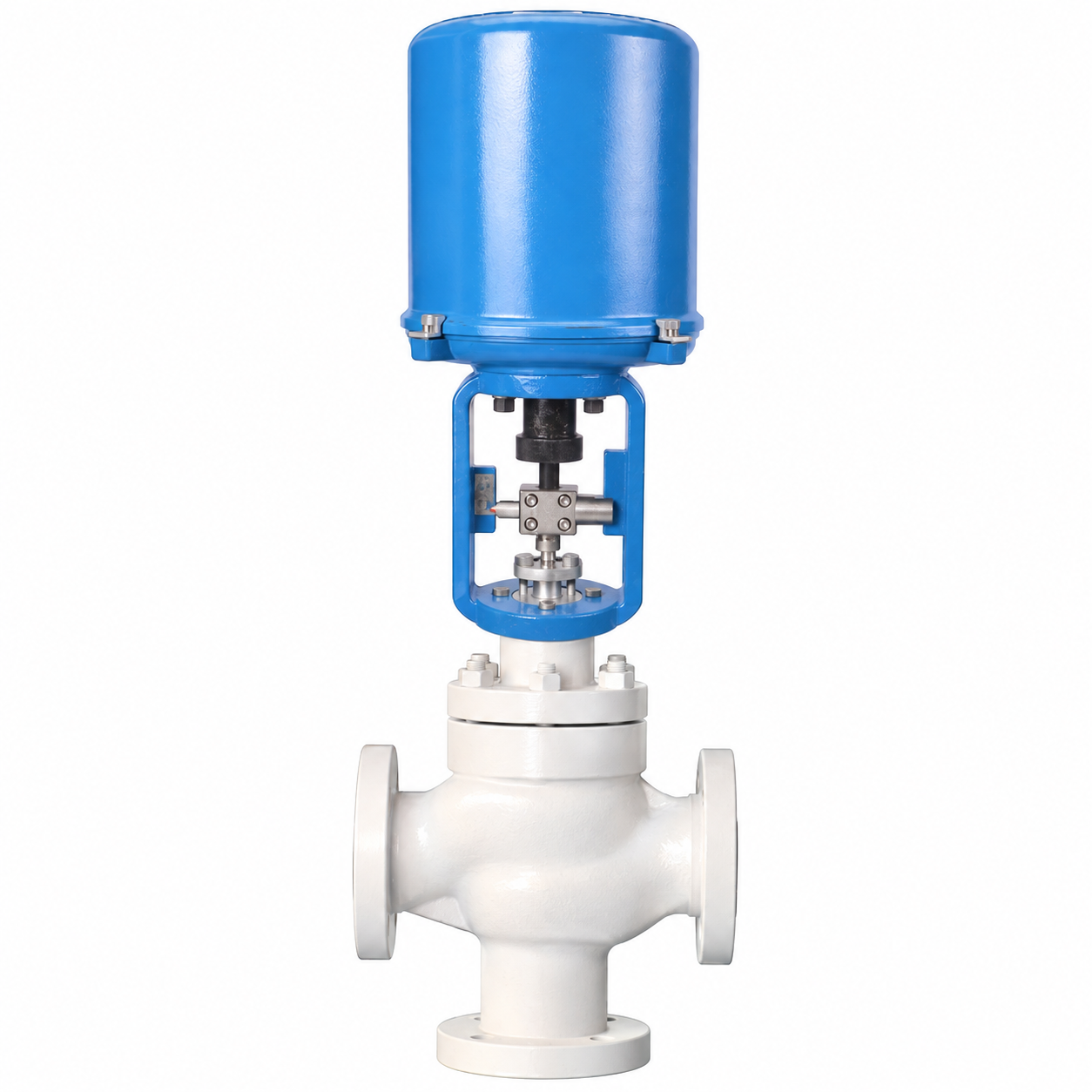
Electric three-way merging regulating valve ZAZL-16C
Fouten Flow Control (Jiangsu) Co., Ltd. specializes in producing electric three-way merging regulating valve ZAZL-16C, which consists of an angular stroke electric actuator and a three-way merging valve body. It is suitable for automatic control systems in industries such as chemical, petroleum, power, metallurgy, HVAC, etc. that require proportional merging or splitting regulation of two fluids.
Form of Construction
Use L or T three-way valve body structure, with a plunger or sleeve type valve core, and a precision adjustment pair formed by cooperating with the valve seat. The three channels correspond to two intersections and one outlet (merging type) or one inlet and two outlets (diverging type), and the opening of each channel is changed by rotating and lifting the valve core to achieve proportional distribution of the flow rate of the two media channels. The actuator is an angular stroke electric device with stable output torque. It can be equipped with a 4-20mA adjustment module to achieve continuous proportional control, or a switch type actuator can be used for on-off switching.
Main material
Body: Cast WCB, stainless steel CF8/CF8M, chromium molybdenum steel WC6, etc; The valve core/seat is made of stainless steel 304/316, which can be welded with Stellite alloy or sealed with PTFE soft seal; Valve cover: made of the same material as the valve body; Packing: PTFE V type packing or graphite; Valve stem: stainless steel 2Cr13/304/316; Execution mechanism: Aluminum alloy or steel casing with built-in servo control module.
Sealing and Drive
The sealing form can be PTFE soft seal or metal hard seal. The soft seal leakage level can reach ANSI/FCI 70-2 Class IV or VI level, and the hard seal is suitable for high temperature and high pressure working conditions. The driving type is an electric actuator, and the power supply AC220V/380V is optional. The input signal 4-20mA or 1-5VDC can automatically adjust the flow ratio, combined temperature, or mixed concentration of the two media. Support the integration of multiple control strategies such as split range control and cascade control into the DCS/PLC system.
Technical quantity
Nominal caliber: DN25 to DN300; Nominal pressure: PN1.6~PN2.5MPa; Applicable temperature: - 29℃~350℃ (depending on the material and sealing structure); Applicable media: steam, hot water, liquid, and weakly corrosive media; Traffic characteristics: equal percentage or linear; Adjustable ratio: 50:1; Connection method: flange FF/RF; Design standards: GB/T, 4213, IEC, 60534.
Applicable Industries
Widely used in industrial control systems such as petrochemicals, refining, natural gas, electricity, metallurgy, papermaking, food, manufacturing, HVAC, etc., it is suitable for controlling two different temperatures, pressures, or processes In situations where the components of the medium are mixed according to specific regulations, such as cold and hot water mixing, bypass regulation, and recirculation control for uniform mixing conditions.
Product Advantages
1. triple junction structure replaces two pedestal valves with one valve, saving installation space and cost; 2. electric drive, intelligent control, capable of remote operation and centralized monitoring; 3. valve core guidance accuracy, stable adjustment, and anti vibration performance; 4. has precise flow characteristics, adjustable ratio, and accurate control of mixing ratio; 5. material selection is flexible and can adapt to temperature, low temperature, and corrosive media; 6. is equipped with an intelligent stabilizer, supporting DCS/PLC system integration and fault self diagnosis.
Execution mechanism configuration
Standard configuration intelligent electric actuator, output torque 100N · m~1500N · m, with overload protection, manual operation, position feedback, fault diagnosis and other functions. Adjustable blocks, on-site wheels, explosion-proof external heating devices, etc., meet different working conditions and control requirements. 1590 seconds between actions (depending on caliber and torque).
Selection Instructions
When placing an order, please provide information such as nominal diameter, working pressure, medium name and temperature, combined or flow type, flow characteristic requirements, parameters of two media channels, connection standards, driving mode (electric switch type/regulating type), power specifications, whether explosion-proof is required, valve body and sealing surface material quality, etc. For high media, it is recommended to choose a heat dissipating valve cover or a metal hard seal structure. For media containing particles, it is recommended to choose a hardened valve core.
Installation and maintenance
During installation, the direction of the valve body arrow should be aligned with the flow direction of the medium, and the connections of each channel in the three-way valve should correspond correctly to the process pipeline. The flange connection bolts should be symmetrically and evenly fastened. The connection of the electric actuator should comply with the electrical grounding standard. Before putting into use, conduct a no-load test run to check that the switch action, limit setting, and signal feedback are normal, and perform parallel two-way proportional verification. Regularly check the sealing of the valve seat and the lubrication condition of the actuator to ensure long-term stable operation.
Fouten Flow Control (Jiangsu) Co., Ltd. can provide selection calculation, drawing confirmation, complete set of goods and debugging services according to user working conditions. Welcome to inquire by phone.
Common problems in product selection
How to connect the three interfaces of ZAZL-16C for mixing hot and cold water?
The two inlet and common outlet should be confirmed according to the corresponding merging structure diagram, and the temperature, pressure, and flow rate of each channel should be provided. Do not install the merging valve directly according to the interface of the diverging valve.
Can ZAZL-16C still mix stably with different inlet pressures?
The minimum, normal, and maximum pressures of the two channels should be used together with the flow rate for calculation, and the flow coefficient, allowable pressure difference, and control circuit of each channel should be checked. Providing only the diameter of the main pipe is not sufficient to determine the effectiveness of the mixing adjustment.
What electric configurations are required for ZAZL-16C to connect to a temperature control system?
Control input, position feedback, power supply, and fault safety requirements should be separately confirmed, and actuator stroke and output force should be checked. The output form of the temperature sensor or controller must match the input of the actuator.
 Home
 Valve selection
 news information
 Contact us