


 简体中文
 Japanese
 Korean
 Russian
 繁体中文
 Español
Valve selection
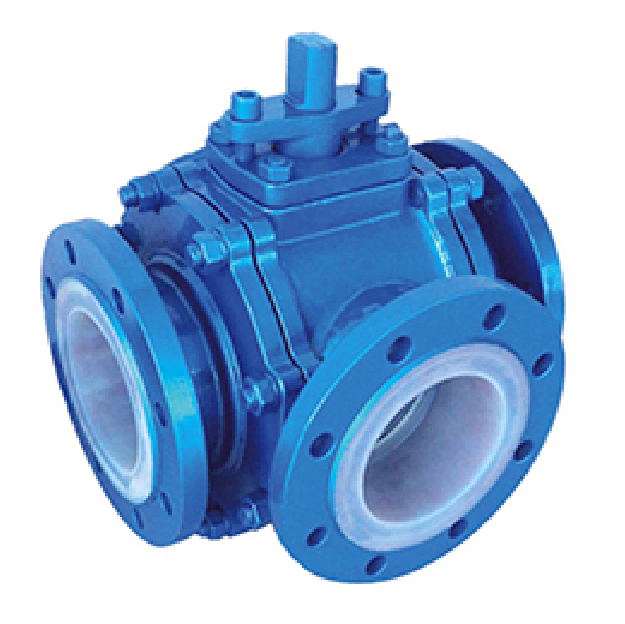
Q44F46 manual fluoropolymer-lined three-way flange ball valve (PFA/FEP optional)
Q44F46 manual fluoropolymer-lined three-way flange ball valve
This model is designed with manual drive, three-way flow path, flange connection, and fluoroplastic lining as the selection direction. The metal valve body provides structural support, and the lining and valve seat are in contact with the medium. Suitable for flow switching pipelines that require evaluation of corrosion-resistant materials, it is not a four-way ball valve, and all three-way openings cannot be described as having the same connectivity function.
How to confirm the flow paths of L and T
The L type is typically used for reversing between two channels, while the T type can achieve specific combinations of connection, diversion, or merging, but the final function depends on the number of ball openings, valve seats, and limit positions. When purchasing, three interface numbers and a connectivity table for each valve position should be provided, indicating whether intermediate position flow is allowed and whether the common port needs to be completely closed. It is not enough to only write three words: three-way valve.
PFA, FEP, and PTFE are not made of the same material
FEP commonly uses the F46 logo, PTFE commonly uses the F4 logo, and PFA is another type of meltable fluoroplastic, all of which cannot be written as polytetrafluoroethylene. The PFA/FEP listed in this article is an existing supply option, and the specific lining and seat materials should be confirmed separately; If PTFE is required, a separate structure and material scheme is needed, and the default configuration cannot be inferred from the option name.
Caliber, pressure and metal shell
The existing series of calibers DN40-DN600, pressure PN16 or Class150, specific dimensions and material combinations shall be determined according to the confirmed drawings, and PN and Class cannot be directly exchanged. The selection of WCB and stainless steel shell should also consider external corrosion, load, and temperature; Lining does not mean that the shell material is completely unaffected by working conditions. Allow temperature, pressure difference, and negative pressure capacity to be simultaneously constrained by the lining structure, valve seat, and sealing components.
Corrosive media and operational requirements
Please provide the name, concentration, impurities, temperature, pressure, flow rate, and whether there are particles, crystals, permeation, or vacuum pumping of the medium for inquiry. The position of the handle should be based on the flow direction identification and valve diagram, and the clockwise and counterclockwise rules of two-way ball valves cannot be used to infer the opening and closing of all three-way ports. When frequent commutation, automation, or special fault positions are required, separate calculations are made for the drive and limit.
Installation and maintenance
First, check the three end pipeline numbers, flanges, face distance, and valve body direction. The pipeline is independently supported and does not rely on three end bolts for forced correction. The lining flange gasket and fastening method should be executed according to the specific instructions to prevent crushing of the lining or hard particles entering the valve chamber. Before maintenance, isolate, drain and confirm that there is no residual pressure in each channel and valve chamber of the three-way valve.
Common problems in selection and procurement
I want to cut a bucket of acid into two devices. Should I choose L or T?
List three interfaces and the channels that are allowed to be connected at each workstation, indicating whether it is allowed to supply two devices simultaneously, whether all devices need to be turned off, and whether mixed flow is allowed. Determine the opening and valve position of the sphere based on the connectivity table, and cannot simply choose L or T based on the two words' diversion '.
Can the same acid still use the original FEP lining after increasing the temperature?
It is necessary to recheck the concentration, impurities, temperature, pressure, and permeation conditions, and evaluate them together with the valve seat, packing, and negative pressure capacity. Just because it operates normally at room temperature, it cannot be assumed that it is still applicable after heating up. If necessary, compare options such as PFA.
Can the shutdown branch maintain complete isolation when switching three-way valves?
The requirements for channel connectivity and sealing at the endpoint and switching intermediate positions should be confirmed. If the shutdown of the branch involves maintenance or hazardous media, independent isolation measures required by the process must be adopted, and the three-way reversing position cannot be equated with safety maintenance isolation.
 Home
 Valve selection
 news information
 Contact us