


 简体中文
 Japanese
 Korean
 Russian
 繁体中文
 Español
Valve selection
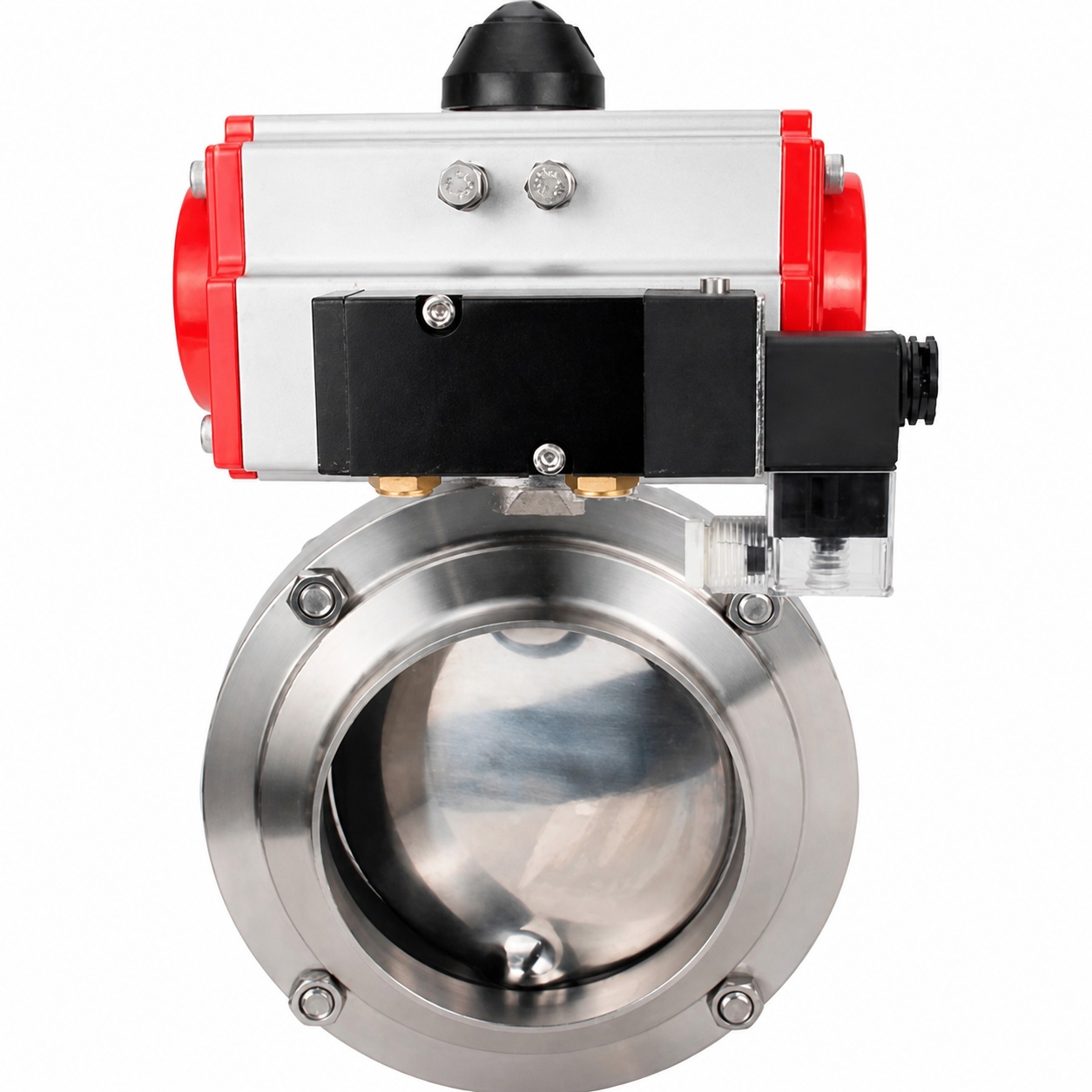
Pneumatic sanitary butterfly valve D673W-10P
D673W-10P Pneumatic Sanitary Butterfly Valve
Product Specifications
| Product Model | D673W-10P |
| Structural form | Sanitary grade disc-shaped quick installation structure |
| Nominal Diameter | DN40-DN200 |
| pressure rating | PN10 |
| Valve body material | CF8M/316L |
| sealing form | Food grade silicone/EPDM |
| Drive Type | Double acting pneumatic actuator and solenoid valve |
| Applicable temperature | -10℃ to 150℃ |
| Applicable Medium | Clean water, beverages, dairy products, and process fluids |
Structure and Application
D673W-10P pneumatic sanitary butterfly valve adopts a sanitary disc quick installation structure, which is designed for automatic opening and closing or flow control of food, beverage, pharmaceutical and clean process systems. The sanitary grade flow channel and quick installation interface are easy to disassemble and clean, and the mirror surface is connected to the liquid level to reduce the risk of residual media. Project selection should not only be based on the connection diameter, but should also synchronously confirm the medium state, design pressure, normal temperature, maximum pressure difference, operating frequency, allowable leakage level, and on-site control signals to avoid mismatch between valve mechanical capabilities and system operating conditions.
Specifications and materials
The nominal diameter of this model covers DN40-DN200, with a pressure rating of PN10. The valve body material can be configured according to CF8M/316L. Material selection should take into account the corrosiveness of the medium, chloride ion content, erosion particles, and environmental temperature; When there are low temperature, high temperature or frequent thermal cycles, the material combination of the valve stem, fasteners and packing should also be checked, and the diameter and pressure standards should be unified in the ordering documents.
Sealing and Media
D673W-10P uses food grade silicone/EPDM, with a suitable temperature range of - 10℃ to 150℃. The choice of sealing pair will affect the closing performance, operating torque, and maintenance cycle. For clean water, beverages, dairy products, and process fluids, the risks of scaling, wear, adhesion, and cavitation should be evaluated separately; When a stricter leakage level is required, the sealing form should be determined under the premise of meeting temperature and pressure difference conditions, and a single material cannot cover all working conditions.
Drive and Control
The driving part adopts a double acting pneumatic actuator and solenoid valve, which can be configured with switch quantity, analog quantity, valve position feedback, limit switch and fault interlock according to the control scheme. The output force or torque of the actuator should have a reasonable safety margin, while verifying the action time and power or gas source conditions. The protection level of control cabinets, junction boxes, and accessories should be suitable for indoor, outdoor, humid, or hazardous environments.
Installation requirements
Before installation, the nameplate parameters, flow direction identification, connection dimensions, and random files should be checked, and welding slag, iron filings, and sealing residues in the pipeline should be removed. The pipelines at both ends of the valve must be coaxial and independently supported, and it is forbidden to forcefully straighten them with fastening bolts. When lifting, the valve body or designated lifting point should be selected, and cables, air pipes, handwheels, and actuator housings should not be used as load-bearing points.
debugging method
The first debugging requires completing a full stroke test under safe isolation conditions, recording the switch position, action time, feedback signal, operating current or gas source pressure. The adjustment purpose should also check the correspondence between the input signal and the actual valve position, and if necessary, perform zero point, range, and dead zone calibration. When encountering jamming, abnormal noise, vibration, or misalignment, the continuous operation should be stopped and the mechanical or control cause should be identified.
operation and maintenance
After being put into operation, a spot check cycle can be established based on the cleanliness of the medium and the number of actions, with a focus on inspecting connecting bolts, valve stem areas, sealing surfaces, actuators, limit devices, and electrical or pneumatic accessories. If there is external leakage, internal leakage, slow response or valve position drift, the problem should be judged based on the process trend to determine whether it comes from the valve internals, driving device or control circuit, in order to avoid increasing the driving force without diagnosis.
Maintenance safety
Before maintenance, the process medium must be cut off, the pressure in the valve chamber must be released, and all power sources must be isolated. During the disassembly process, record the direction and pre tightening status of the parts, and after replacing the seals, tighten them evenly in the prescribed order. Static sealing, movement, and interlocking checks should be conducted before reusing; When dealing with high temperature, flammable or toxic media, on-site work permits, replacement and testing requirements must also be followed.
Selection Guide
Quick installation maintenance, low retention, and automatic switching are the main application features of this product, but actual performance depends on correct caliber calculation, material selection, and control parameters. For transient conditions such as minimum flow rate, bypass operation, pump start stop, or system water hammer, they should be jointly reviewed by the process and self-control specialties. The project documentation should clearly state the medium name, flow range, upstream and downstream pressure, and failure location to facilitate the formation of traceable selection criteria.
order proposals
Fouten Flow Control (Jiangsu) Co., Ltd. suggests providing operating condition data sheets, pipeline grades, connection standards, control signals, and accessory lists when purchasing D673W-10P. After arrival, verify the physical object and technical agreement, and save the debugging records and vulnerable parts information. By standardizing selection, installation, commissioning, and periodic maintenance, the operational stability of pneumatic sanitary butterfly valves in food, beverage, pharmaceutical, and clean process systems can be improved, and the risk of unplanned downtime can be reduced.
Common problems in product selection
Can D673W-10P be directly connected to existing sanitary grade clamp pipes?
It is necessary to verify the outer diameter series of the pipeline, clamp interface, and sealing ring size, and reserve space for the pneumatic actuator. The same DN may not necessarily have the same quick connect size.
Can this sanitary butterfly valve be used for CIP cleaning or SIP steam sterilization?
Please provide the composition of the cleaning solution, cleaning temperature, steam conditions, and duration, and verify the contact material, valve seat and sealing components, as well as the temperature and pressure limits for this configuration; The name 'sanitary grade' cannot replace the validation of cleaning and sterilization conditions.
D673W-10P requires feedback on switch position. What should be specified when placing an order?
The required types of feedback and control interfaces for opening and closing should be specified, and the single or double acting and gas safety positions should be clearly defined; Feedback sensors, solenoid valves, and fault actions need to be confirmed according to the complete configuration.
 Home
 Valve selection
 news information
 Contact us