


 简体中文
 Japanese
 Korean
 Russian
 繁体中文
 Español
Valve selection
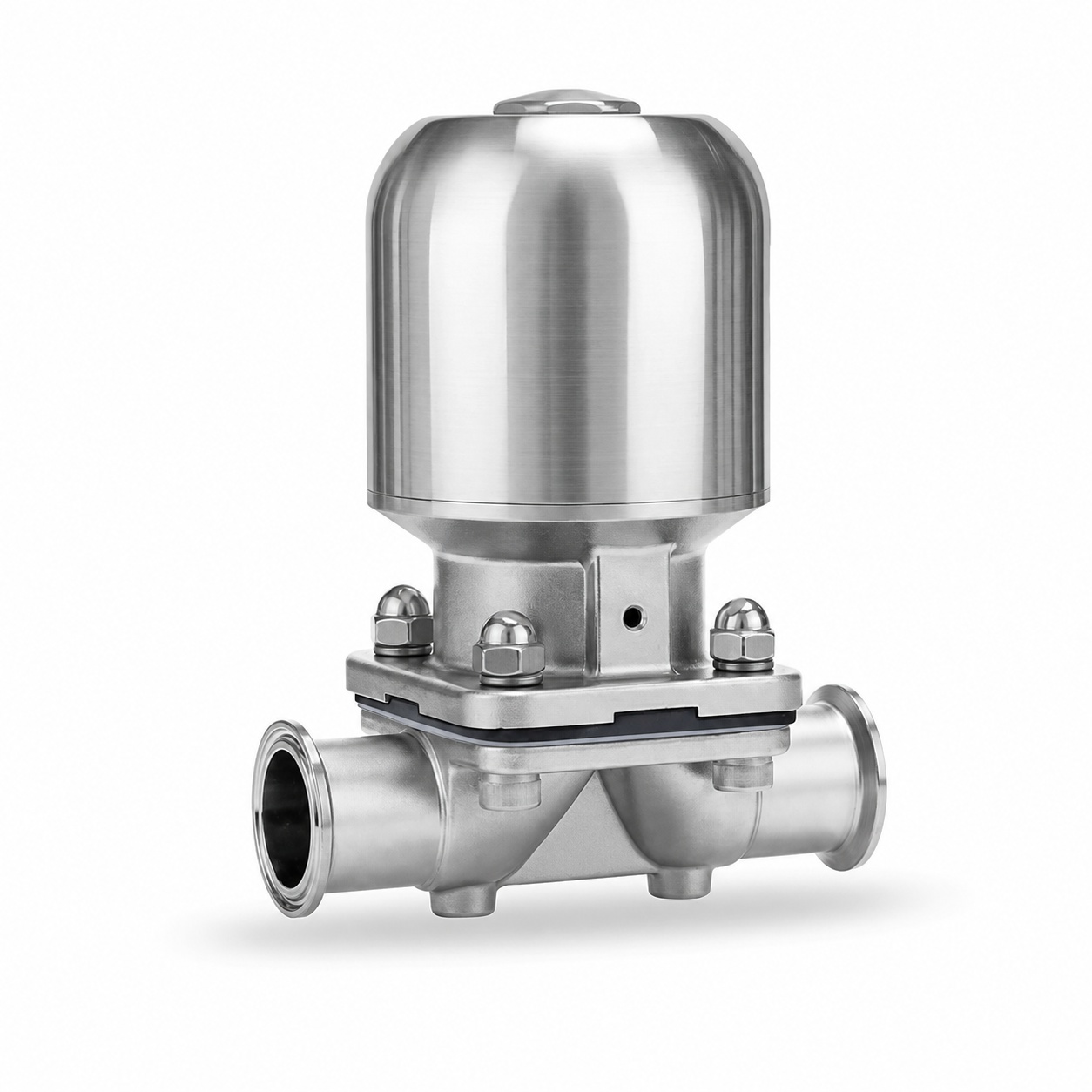
Pneumatic Sanitary Diaphragm Valve DV5603-C
| Specification | Value |
|---|---|
| Model number | DV5603-C |
| Specification and caliber | DN15-DN80 |
| Pressure level | PN10 |
| Material | 316L |
| Product Features | Medium Isolation, Low Dead Space, Online Cleaning |
DV5603-C Pneumatic Sanitary Diaphragm Valve
Product Parameters
| Product Model | DV5603-C |
| Structure Type | Straight-through diaphragm sealing quick-install structure |
| Nominal Diameter | DN15-DN80 |
| Pressure Rating | PN10 |
| Body Material | 316L |
| Sealing Type | EPDM backing/PTFE diaphragm |
| Actuation Method | Normally closed pneumatic piston actuator |
| Applicable Temperature | -10â to 150â |
| Applicable Medium | Clean water, food liquids, and pharmaceutical process media |
Structure and Application
The DV5603-C pneumatic sanitary diaphragm valve features a straight-through diaphragm sealing quick-install structure, driven by a pneumatic piston actuator that compresses the diaphragm to seal with the valve body, completing the opening and closing of the pipeline. The flexible diaphragm isolates the process medium from the drive mechanism. When applied in food, pharmaceutical, or clean pipelines, it is essential to verify the contact materials, quick-install connections, diaphragm configurations, and cleaning requirements. If continuous flow regulation is needed, it must also be confirmed that the valve body and pneumatic control configuration have the corresponding regulating capability; it cannot be assumed to be a control valve solely based on the pneumatic actuator.
Specifications and Materials
This model covers nominal diameters from DN15 to DN80, with a pressure rating of PN10, and the valve body material can be configured to 316L. Material selection should consider the corrosiveness of the medium, chloride ion content, erosive particles, and environmental temperature; in cases of low temperature, high temperature, or frequent thermal cycling, the material combinations of the diaphragm, compression components, connection seals, and fasteners should also be verified, and the order documents should specify the nominal diameter and pressure standards.
Sealing and Medium
The DV5603-C uses a combination of PTFE diaphragm and EPDM backing, achieving valve closure sealing through diaphragm deformation and corresponding compression structure. The PTFE contact layer and EPDM backing serve different functions, and actual applicability needs to consider the medium, working temperature, pressure, and thermal cycling conditions of the diaphragm. Maintenance of the diaphragm valve sealing should focus on diaphragm fatigue, sealing contact surfaces, compression components, and quick-install connection status. Continuous working temperature, cleaning temperature, and short-term sterilization temperature should be evaluated separately; the overall valve capability cannot be judged solely based on the temperature resistance data of a single material.
Drive and Control
The DV5603-C employs a normally closed pneumatic piston actuator, utilizing compressed air to generate linear thrust, driving the diaphragm compression mechanism to complete opening and closing. The actuator selection should verify the available air source pressure, output thrust, valve working pressure differential, and stroke requirements. If position feedback is required, suitable detection accessories can be selected based on specific configurations. If the project requires analog positioning or continuous adjustment, it should be confirmed whether the actuator, positioner, and valve body support the corresponding functions. The closing action after loss of air must also match the actual spring return structure and control circuit.
Installation Requirements
Before installation, verify the nameplate parameters, flow direction markings, connection dimensions, and accompanying documents, and remove pipeline welding slag, iron filings, and sealing residues. The pipelines at both ends of the valve must be coaxial and independently supported; forcing alignment using fastening bolts is prohibited. During hoisting, select the valve body or designated lifting points, and do not use the air pipe, control accessories, or pneumatic actuator casing as bearing points.
Debugging Method
The initial debugging should confirm the action direction, stroke, switch position, and air source connection of the pneumatic actuator under safe isolation conditions, and check the actual action of the normally closed configuration under corresponding loss of air conditions. When equipped with valve position feedback or solenoid valves, the signal and actual valve position correspondence should also be verified. Only when continuous positioning control configuration is clearly adopted should the corresponding positioner debugging be performed. If diaphragm compression anomalies, incomplete actions, air path leaks, or abnormal sounds are found, continuous operation should be stopped, and the diaphragm, actuator, and air path accessories should be checked.
Operation and Maintenance
After being put into operation, the inspection cycle should be determined based on medium conditions, cleaning requirements, and opening and closing frequency, focusing on checking the diaphragm surface, compression mechanism, valve body contact surface, quick-install interface, pneumatic actuator, and its accessories. If there are issues with tight closure, external leakage, or slow action, the diaphragm wear, sealing contact status, air source conditions, and actuator movement should be verified separately; simply increasing the supply pressure cannot compensate for diaphragm or mechanical failures. The assembly and sealing inspection after diaphragm replacement should comply with the actual product maintenance requirements.
Repair Safety
Before repair, the process medium must be cut off, the valve chamber pressure released, and all power sources isolated. During disassembly, record the direction and pre-tightening status of parts, and after replacing sealing components, tighten them evenly in the specified order. Before re-commissioning, static sealing, action, and interlock checks should be performed; when involving high temperature, flammable, or toxic media, on-site work permits, replacement, and testing requirements must also be executed.
Selection Tips
The selection of DV5603-C should focus on contact materials, diaphragm structure, quick-install interfaces, cleaning processes, and pneumatic control requirements. When used in clean systems, it is necessary to verify the surface condition of the 316L contact surface, diaphragm material, and process applicability; for CIP or SIP conditions, the cleaning medium, temperature, pressure, duration, and cycle times should also be specified. The loss of air position of the valve should be consistent with the actual configuration of the normally closed actuator. The sanitary designation itself cannot replace the verification of contact materials, cleanliness requirements, or corresponding certifications.
Ordering Suggestions
Fouten Fluid Control (Jiangsu) Co., Ltd. recommends providing working condition data sheets, pipeline grades, connection standards, control signals, and accessory lists when purchasing the DV5603-C. After arrival, verify the physical items against the technical agreement, and retain debugging records and information on consumable parts. By standardizing selection, installation, commissioning, and periodic maintenance, the operational stability of the pneumatic sanitary diaphragm valve in biopharmaceuticals, food & beverage, and high-purity water systems can be enhanced, reducing the risk of unplanned downtime.
Selection and Usage Information
Materials, sealing, and cleanable structures need to be verified separately, and can be cross-checked with sanitary valve selection for actual selection and installation information. Other similar structures can be found at pneumatic valves.
Common Questions about DV5603-C Pneumatic Sanitary Diaphragm Valve
1. Can the DV5603-C be used for CIP cleaning and SIP steam sterilization?
The DV5603-C can be configured with a 316L valve body, PTFE diaphragm, and EPDM backing as needed. When used for CIP cleaning or SIP sterilization, it is also necessary to verify the temperature and pressure capabilities of the diaphragm assembly, quick-install seals, and valve body contact surfaces, and specify the cleaning agents, duration, and cycle times; a single material designation cannot replace the cleaning validation of the entire valve.
2. Can the DV5603-C quick-install diaphragm valve be directly connected to existing sanitary clamp pipelines?
It is necessary to confirm the actual quick-install interface standards, pipeline outer diameter, clamp connection dimensions, sealing gasket materials, and corresponding pressure and temperature conditions. The same DN does not mean that different sanitary connection systems can be directly interchangeable; when purchasing, the original pipeline interface standards or connection dimension drawings should be provided for verification of compatibility.
3. How often does the PTFE diaphragm of the DV5603-C need to be replaced?
There is no fixed replacement cycle for the diaphragm that applies to all conditions. The replacement timing is related to the medium, temperature, working pressure, opening and closing frequency, cleaning and sterilization cycles, and actual diaphragm structure. Regular inspections should focus on diaphragm fatigue, deformation, cracks, incomplete closure, and external leakage, and a check and replacement plan should be developed based on the corresponding product maintenance requirements. Before maintenance, the medium must be isolated, depressurized, and residual energy in the pneumatic system released.
 Home
 Valve selection
 news information
 Contact us