


 简体中文
 Japanese
 Korean
 Russian
 繁体中文
 Español
Valve selection
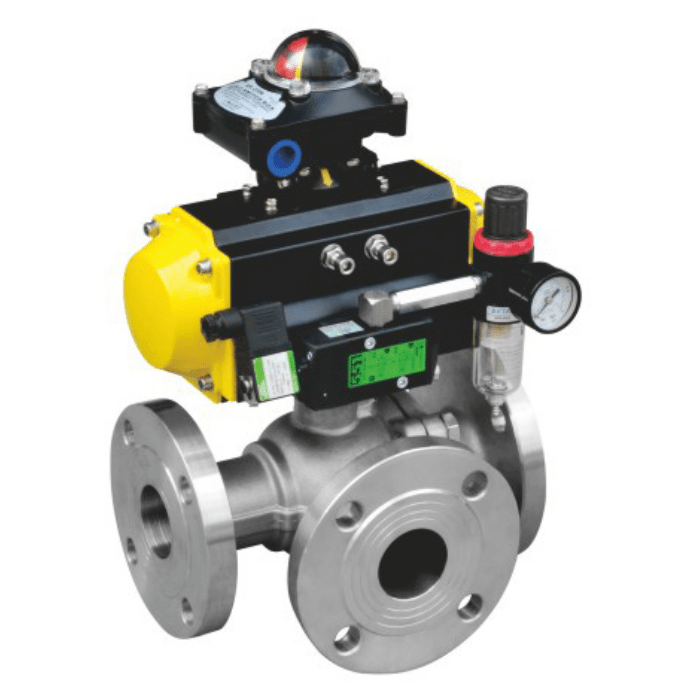
Pneumatic American Standard Flanged Three-Way Ball Valve
| Specification | Value |
|---|---|
| Model number | Q645F |
| Specification and caliber | 1”-36” |
| Pressure level | CLASS150# |
| Material | WCB Cast Steel / 304 Stainless Steel / 316L |
| Product Features | Pneumatic Three-Way, American Standard |
Q645F Pneumatic Three-Way American Standard Ball Valve
The Q645F series product is a Class 150 American standard three-way flanged ball valve, utilizing a pneumatic actuator to achieve flow path switching. The series sizes range from 1 inch to 36 inches, with materials including WCB, 304, and 316L.
Three-Way Flow Path Must Be Confirmed According to Drawings
The connection grade and flow path form of the American standard three-way ball valve are different options. First, determine the communication relationship of each stop position according to process requirements, and then verify the ball core openings, sealing, and drive; do not rely solely on the American standard three-way name to determine the flow path.
Class 150 Cannot Be Expanded to Other Pressure Ratings
This model is selected according to Class 150; other pressure ratings should be verified separately for valve body design, materials, and flange matching. The rated conditions cannot be applied to the same finished product. The actual pressure-temperature rating must also be confirmed in conjunction with the material and design temperature.
How to Configure Pneumatic Accessories?
Accessories can be configured based on control needs, including single-acting or double-acting actuators, solenoid valves, limit feedback, or positioners. Specific air source, explosion-proof, protection, and control functions must be based on actual accessory data.
For general multi-standard three-way structures, refer to Pneumatic Three-Way Flanged Ball Valve (Q645F); for more pneumatic ball valves, see Pneumatic Ball Valve Selection.
When Replacing Old Pneumatic American Standard Three-Way Ball Valve, How to Avoid Incorrect Interface Direction?
Please provide a site diagram with pipe port numbers, flow path requirements, and the original valve structure length, and then verify the flange, ball core openings, and each stop position. The American standard pressure rating and three-way flow path have different requirements, both of which should be clearly stated in the order.
Control accessories should be matched according to working positions and fault states, ensuring that the position signal corresponds to the actual flow path. For systems that need to prevent mixing of materials, the communication relationship of the ports during the rotation of the valve core and the residual in the valve chamber should also be checked, and appropriate separation and interlocking should be set.
Frequently Asked Questions
Is Class 150 Fixed at 150 PSI?
No, Class 150 is a pressure rating name; the specific pressure-temperature rating is related to the material and temperature.
Is Q645F Default to T-Type Flow Path?
This should be confirmed according to the specific ball core openings and the communication diagram of each stop position. If L-type, T-type, or other flow paths are required, they should be specified separately; the model abbreviation cannot replace the actual flow path diagram.
Is Pneumatic Three-Way Ball Valve Always Suitable for Continuous Proportional Adjustment?
Not necessarily; three-way switching and continuous adjustment are different requirements and need to be judged based on valve body structure and control configuration.
 Home
 Valve selection
 news information
 Contact us