


 简体中文
 Japanese
 Korean
 Russian
 繁体中文
 Español
Valve selection
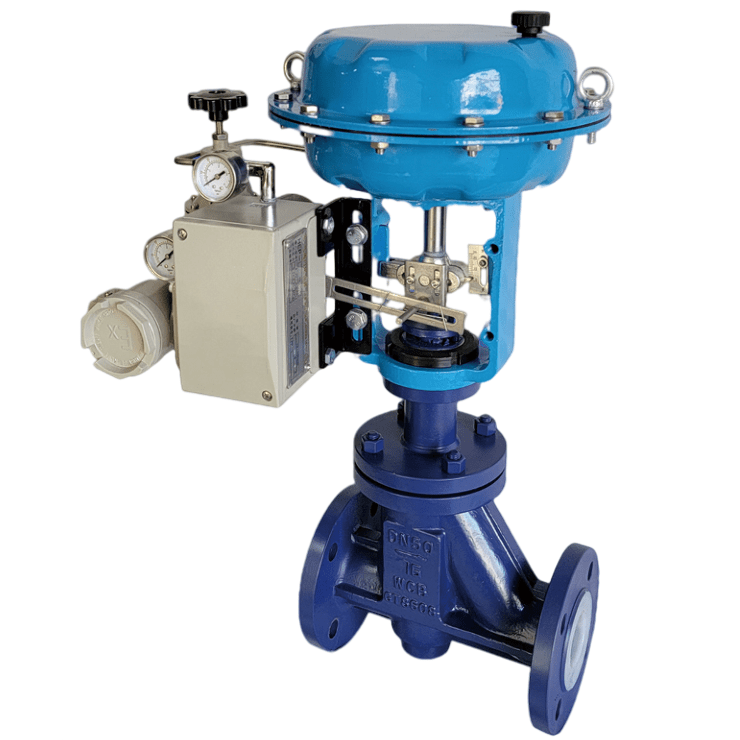
Pneumatic American standard fluoropolymer-lined regulating valve Class150
The pneumatic American standard flange connection fluoropolymer-lined regulating valve Class150 is a valve device designed for controlling highly corrosive media. The valve body follows the ASME B16.5 standard design, and the flange sealing surface adopts the RF protruding surface form, matched with the Class150 pressure rating, suitable for the PN16-PN20 working condition system. The main material can be WCB carbon steel or CF8 stainless steel. The inner cavity is lined with a thick layer of 2.5-3mm perfluoroethylene propylene (F46) or PFA/PTFE through compression molding process, forming a seamless anti-corrosion isolation layer that can withstand the corrosion of acid and alkali media within the range of PH values and 0-14.
The actuator adopts a multi spring diaphragm or piston pneumatic structure, equipped with an intelligent locator and an air filtration and pressure reduction unit, and supports 4-20mA signal input for precise flow regulation. The guiding mechanism is equipped with PTFE wear-resistant ring and graphite packing combination seal, which needs to meet the low leakage requirements of TA-Luft standard for volatile media while maintaining flexible movement. The valve core component adopts a pressure balanced design, which offsets the axial force generated by the medium pressure difference through the balance hole at the bottom of the valve stem, reducing the load on the actuator above 30%.
The fluorine lining process adopts separate sintering molding technology, and the inner cavity of the valve body, valve seat, and valve core surface are all coated with a layer of fluoroplastic. After secondary high-temperature curing treatment, the bonding strength between the lining layer and the metal substrate reaches 15MPa or above. The contour of the flow channel is optimized through CFD fluid simulation, and designed with equal percentage or parabolic flow characteristics. The linear adjustment accuracy can reach ± 2.5%FS. The specially designed guide wing structure can reduce medium eddies and control fluid noise within 85dB (A).
This valve is suitable for strong corrosive medium control systems in industries such as chemical, pharmaceutical, and electroplating. It has stable protective performance especially for special media such as concentrated sulfuric acid, hydrofluoric acid, and mixed organic solvents. The protection level of the actuator shell meets the IP66/IP67 standard, and an explosion-proof locator can be optionally equipped to meet the requirements of Zone1 hazardous area use. The valve seat and valve core adopt a conical sealing structure, and the installation deviation is automatically corrected by an elastic compensation mechanism to ensure that the ANSI/FCI 70-2 Class IV level seal is maintained within the temperature range of - 20℃ to 150℃.
Conduct 1.5 pressure shell test and 0.6MPa nitrogen sealing test before leaving the factory, and provide third-party material composition report. During maintenance, the packing sealing components can be replaced online, and the fluoropolymer-lined valve core and valve seat support can be disassembled and replaced as a whole, significantly reducing maintenance costs. According to the characteristics of the medium, different fluoroplastic liners such as PFA and ETFE can be selected to meet the temperature and penetration resistance requirements under specific working conditions.
Common problems in product selection
TJ6 pipeline is DN50, must the regulating valve also be selected as DN50?
not always. Please provide the minimum, normal, and maximum flow rates, upstream and downstream pressures, media, and temperature. First, calculate Cv/Kv and the available opening range, and then determine the valve diameter; Choosing too large may also make small flow regulation unstable.
Do I need to confirm the input signal and valve position feedback when connecting TJ6 to DCS?
It is necessary to confirm the control input, valve position feedback, power or gas source conditions, interfaces, and fault location separately. Input and feedback are not the same function, and it cannot be assumed that all analog signals or communication protocols are fully equipped based solely on the name "regulating type".
TJ6 needs to be turned off after gas interruption. How should the actuator be configured?
The safety position required for the process in case of gas loss should be clarified first, and then the single or double acting scheme, output force or torque, and accessory circuit should be checked. You cannot select cylinders based solely on valve diameter, nor can you assume that all pneumatic configurations will close when there is a loss of air.
 Home
 Valve selection
 news information
 Contact us