


 简体中文
 Japanese
 Korean
 Russian
 繁体中文
 Español
Valve selection
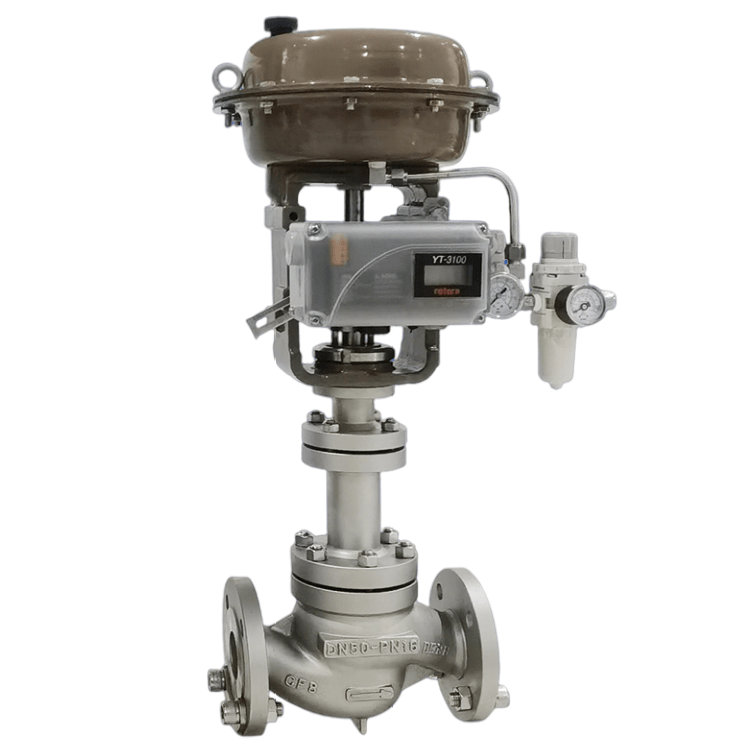
Thin film pneumatic bellows flow control valve
The thin film pneumatic bellows flow control valve achieves precise regulation of pipeline medium flow through the synergistic effect of flexible bellows structure and thin film actuator. The core design adopts multi-layer metal bellows as the valve stem sealing component, replacing the traditional packing sealing form, which can effectively avoid the problem of medium leakage and is suitable for corrosive, high-temperature or clean fluid conditions with high sealing requirements. The actuator of this valve consists of an elastic diaphragm, a spring component, and an air chamber. The diaphragm is driven to deform by the 4-20mA standard signal or pneumatic pressure signal, which drives the linear displacement of the valve core and changes the flow cross-sectional area. The bellows component and valve stem adopt an integrated design, which maintains flexible contact between the sealing surface and the valve seat during dynamic adjustment, which can adapt to frequent opening and closing requirements and reduce mechanical wear. The valve body is usually made of corrosion-resistant materials such as 316L stainless steel and Hastelloy, combined with a hard alloy seat structure, which significantly improves the service life of the valve in high-pressure and particle containing environments.
In terms of technical features, the bellows sealing structure can reduce the maintenance frequency of 90% and above compared to traditional packing sealing, making it particularly suitable for control scenarios involving toxic and harmful media or high-purity fluids. The response time of the actuator is controlled within the range of 0.5-3 seconds, supporting proportional integral derivative (PID) adjustment mode, and can seamlessly integrate with the DCS system. Some models are equipped with manual operation wheels and opening indicators to ensure that emergency operations can still be carried out in the event of power outages or gas source failures.
The application fields cover industries with strict hygiene requirements such as fine chemicals, biopharmaceuticals, and food processing, especially suitable for precise control of steam thermal systems, vacuum pipelines, and high viscosity fluids. By adjusting the number of corrugated tube layers, membrane material, and spring stiffness, it can be adapted to the temperature range from - 50℃ to 450℃ and the pressure rating of PN16-PN100.
In terms of maintenance, modular design is adopted, and the bellows components and valve body can be quickly separated and replaced, reducing downtime. It is recommended to regularly check the cleanliness of the air source filtration device and monitor the fatigue status of the bellows. Calibration should be carried out when the adjustment accuracy deviation exceeds ± 2%. Through structural optimization, this type of valve reduces the fluid resistance coefficient to below the 60% of traditional valves while ensuring regulation accuracy, resulting in significant energy-saving benefits.
Common problems in product selection
ZSHS is used for toxic media. Can corrugated pipes replace all sealing inspections?
No. The sealing of corrugated pipes and the sealing of valve seats have different requirements. It is also necessary to check the material of the corrugated pipes, the cycling conditions, the packing and other leakage paths, as well as the inspection requirements corresponding to the medium; The name of the bellows alone cannot guarantee that the entire valve is leak free.
Do I need to confirm the input signal and valve position feedback when connecting ZSHS to DCS?
It is necessary to confirm the control input, valve position feedback, power or gas source conditions, interfaces, and fault location separately. Input and feedback are not the same function, and it cannot be assumed that all analog signals or communication protocols are fully equipped based solely on the name "regulating type".
ZSHS needs to be turned off after gas interruption. How should the actuator be configured?
The safety position required for the process in case of gas loss should be clarified first, and then the single or double acting scheme, output force or torque, and accessory circuit should be checked. You cannot select cylinders based solely on valve diameter, nor can you assume that all pneumatic configurations will close when there is a loss of air.
 Home
 Valve selection
 news information
 Contact us