


 简体中文
 Japanese
 Korean
 Russian
 繁体中文
 Español
Valve selection
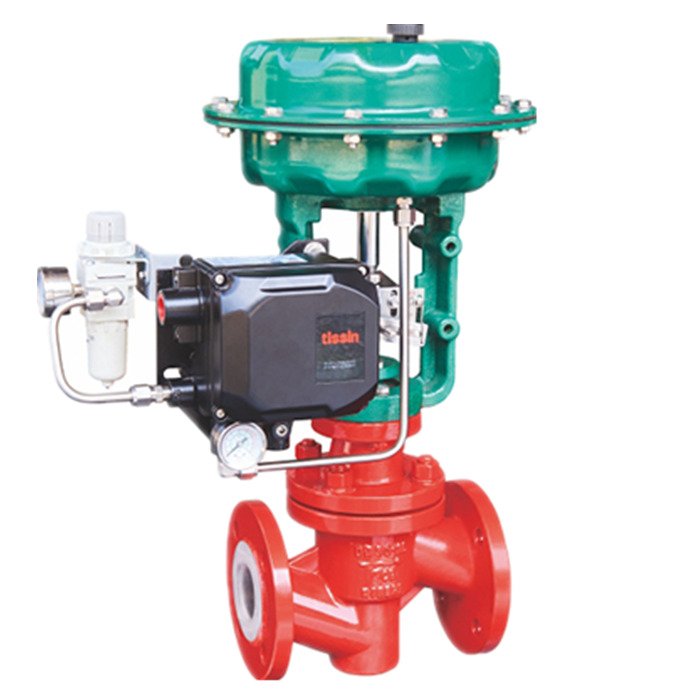
Thin film pneumatic bellows flow control valve
Pneumatic lined PTFE flow control valve is a fluid control device designed specifically for highly corrosive media. It drives the displacement of the valve core through a pneumatic actuator, combined with the anti-corrosion process of lined PTFE (PTFE), to achieve precise flow control of acid, alkali, organic solvents and other media in the pipeline. The core structure adopts the molding and sintering process to fully coat the PTFE material on the valve body flow channel and valve core surface, forming a uniformly thick chemical inert protective layer that can withstand extreme corrosion environments within the range of PH values and 0-14Avoid direct contact between metal components and media.
The valve actuator consists of a cylinder, piston, and spring reset device, supporting 0.4-0.7MPa air source pressure input, and achieving valve opening and closing or proportional adjustment through solenoid valve switching. The valve seat seal adopts the PTFE enhanced lip seal ring and the conical surface matching structure of the metal valve core. Under the working pressure of 0.01-1.6MPa, it can achieve a sealing level of VI, with a leakage rate less than the rated flow rate of 0.01%. The specially designed corrugated pipe sealing component and multi-level packing box work together to double block the possibility of medium leakage along the valve stem, and meet strict environmental standards such as EPA and FDA.
In terms of technical advantages, the bonding strength between the PTFE lining layer and the metal substrate after high-temperature curing is above 15MPa, and there is no risk of delamination under the working conditions of - 30℃ to 180℃. The valve body flow channel has been optimized by fluid dynamics, reducing the flow resistance coefficient compared to traditional structures. 35% is suitable for controlling the transportation of high viscosity slurries or easily crystallizable media. The actuator comes standard with a locator and position feedback device, with linearity deviation controlled within ± 1.5%FS. It supports communication protocols such as MODBUS and HART to connect to industrial control systems.
Typical application scenarios include acid metering in electroplating production lines, distribution of hydrofluoric acid in the photovoltaic industry, and control of strong corrosive media such as solvent feeding in pharmaceutical reaction vessels. By customizing the valve seat hardening treatment (such as tungsten carbide spraying) or installing a scraper cleaning structure, it can be extended to corrosive mud conditions containing solid particles. The product needs to comply with the ISO 15848 low leakage standard, and special models need to pass the NACE MR0175 hydrogen sulfide environmental certification, suitable for use in explosion-proof areas such as chemical and metallurgical industries.
Common problems in product selection
TJ641F46 is used for toxic media. Can corrugated pipes replace all sealing inspections?
No. The sealing of corrugated pipes and the sealing of valve seats have different requirements. It is also necessary to check the material of the corrugated pipes, the cycling conditions, the packing and other leakage paths, as well as the inspection requirements corresponding to the medium; The name of the bellows alone cannot guarantee that the entire valve is leak free.
Do I need to confirm the input signal and valve position feedback when connecting TJ641F46 to DCS?
It is necessary to confirm the control input, valve position feedback, power or gas source conditions, interfaces, and fault location separately. Input and feedback are not the same function, and it cannot be assumed that all analog signals or communication protocols are fully equipped based solely on the name "regulating type".
TJ641F46 needs to be turned off after gas interruption. How should the actuator be configured?
The safety position required for the process in case of gas loss should be clarified first, and then the single or double acting scheme, output force or torque, and accessory circuit should be checked. You cannot select cylinders based solely on valve diameter, nor can you assume that all pneumatic configurations will close when there is a loss of air.
 Home
 Valve selection
 news information
 Contact us