


 简体中文
 Japanese
 Korean
 Russian
 繁体中文
 Español
Valve selection
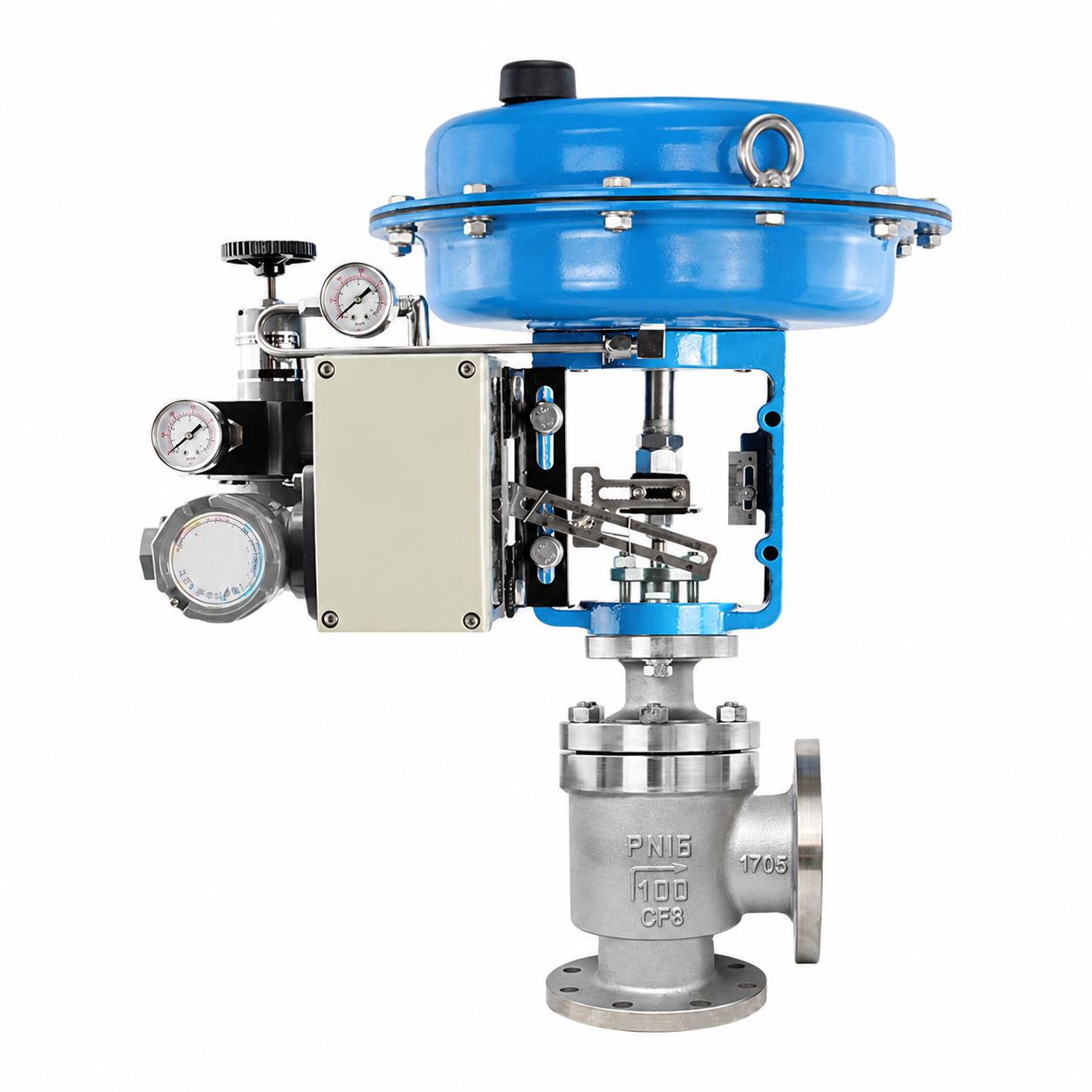
Thin film pneumatic angle regulating valve HPA-16C
1、 Product Overview
The diaphragm pneumatic angle regulating valve HPA-16C is a high-performance flow and pressure regulating equipment developed by Fouten Flow Control (Jiangsu) Co., Ltd. for industries such as chemical, petrochemical, power, and metallurgy. This valve adopts an angular valve body structure, with the valve core arranged at a right angle to the flow direction of the medium, which can effectively reduce pressure drop and improve flow field distribution. It is suitable for pipe sections that require precise adjustment and have limited installation space. Equipped with a thin film pneumatic actuator, it has sensitive response and smooth action, and can achieve continuous adjustment and control of medium flow rate, pressure or liquid level.
2、 Structural form and working principle
The HPA-16C thin film pneumatic angle regulating valve consists of an angle valve body, valve internals, thin film actuator, locator, and accessories. The angled valve body changes the flow direction of the medium inside the valve, which is beneficial for reducing cavitation and erosion; The single seat or sleeve type valve core structure can be selected according to the working conditions, and the balanced valve core can reduce the unbalanced force and improve the stability of small opening. The thin film actuator receives control signals or gas source pressure from 4-20mA, drives the valve stem to move the valve core up and down, changes the flow area, and achieves proportional adjustment. Can be equipped with an intelligent locator, supporting split range control, feature correction, and remote communication.
3、 Main technical parameters
Model: HPA-16C; Specification and caliber: DN15-DN600; Pressure level: PN1.6-PN6.4MPa (Class150-Class300 optional); Valve body material: cast steel WCB, stainless steel 304/316/316L; Valve core/seat: stainless steel+hard alloy or PTFE soft seal; Leakage level: hard seal IV level, soft seal VI level; Applicable media: water, steam, oil, weak acids and bases, and general industrial gases; Medium temperature: - 20℃ to+425℃ (depending on the material and seal); Connection method: flange type (GB/T, HG/T, ANSI, DIN); Drive mode: thin film pneumatic, air source 0.4-0.7MPa; Control mode: 4-20mA, 0-10V or switch quantity, can be equipped with valve positioner, filter pressure reducing valve, solenoid valve, etc.
4、 Product Features
The angular structure has low pressure drop and good anti erosion performance, suitable for high pressure differential working conditions; The membrane actuator has a compact structure, stable thrust output, and high adjustment accuracy; The valve core is interchangeable, making it easy to maintain and manage spare parts; Multiple flow characteristic curves can be selected to meet process requirements such as linearity and equal percentage; The stuffing box and guiding structure have been optimized, and the control indicators for external and internal leakage meet industry standards; Support handwheel mechanism and fault self maintenance configuration to enhance system safety redundancy.
5、 Applicable working conditions and industries
Widely used in petrochemical distillation, catalysis, hydrogenation units, power plant boiler temperature and pressure reduction systems, metallurgical blast furnace gas and hot blast furnace pipelines, municipal heating and HVAC water systems, as well as pharmaceutical, food, paper and other applications that require precise flow regulation. For media containing particles, high viscosity, or prone to crystallization, it is recommended to specify the operating conditions when selecting, in order to configure hardened valve cores or insulation jacket structures.
6、 Material and Manufacturing Standards
The valve body and internal components are made of materials selected and manufactured according to standards such as GB/T12224 and HG/T20592. The pressure parts undergo spectral testing and non-destructive testing to ensure batch consistency. The filling material adopts flexible graphite or PTFE+V combination structure, which is suitable for sealing requirements under frequent adjustment conditions. The actuator diaphragm is made of oil resistant rubber or fluororubber, and the spring and push rod are treated with surface anti-corrosion to adapt to humid and slightly corrosive environments. Before leaving the factory, each valve undergoes shell strength, sealing, and action tests, and is accompanied by a product certificate and inspection report.
7、 Selection and Installation Instructions
Selection requires providing information such as medium name, temperature, pressure, flow range, allowable pressure drop, pipeline diameter and connection standards, control signal type, etc. During installation, attention should be paid to the flow direction identification of the medium, and the actuator should be easy to maintain and leave sufficient space; The gas source needs to be dried and filtered, and the locator needs to complete zero and range calibration according to the instructions. For high-temperature steam or low-temperature media, it is recommended to install extended valve covers or cold insulation structures to reduce heat loss and condensation risks. Fouten Flow Control (Jiangsu) Co., Ltd. can provide calculation sheets, structural diagrams, and complete accessory configuration schemes based on operating conditions to ensure stable operation of HPA-16C in the target system.
Common problems in product selection
Can HPA-16C directly replace the existing straight through regulating valve?
The interface direction of the angle valve is different from that of the straight through valve, and the installation size, flow direction, flow coefficient, and allowable pressure difference should be checked; The proximity of the elbow positions on site does not necessarily mean that they can be directly replaced. It is also necessary to check the pipeline support and actuator maintenance space.
Do I need to confirm the input signal and valve position feedback when connecting HPA-16C to DCS?
It is necessary to confirm the control input, valve position feedback, power or gas source conditions, interfaces, and fault location separately. Input and feedback are not the same function, and it cannot be assumed that all analog signals or communication protocols are fully equipped based solely on the name "regulating type".
HPA-16C needs to be turned off after gas interruption. How should the actuator be configured?
The safety position required for the process in case of gas loss should be clarified first, and then the single or double acting scheme, output force or torque, and accessory circuit should be checked. You cannot select cylinders based solely on valve diameter, nor can you assume that all pneumatic configurations will close when there is a loss of air.
 Home
 Valve selection
 news information
 Contact us