


 简体中文
 Japanese
 Korean
 Russian
 繁体中文
 Español
Valve selection
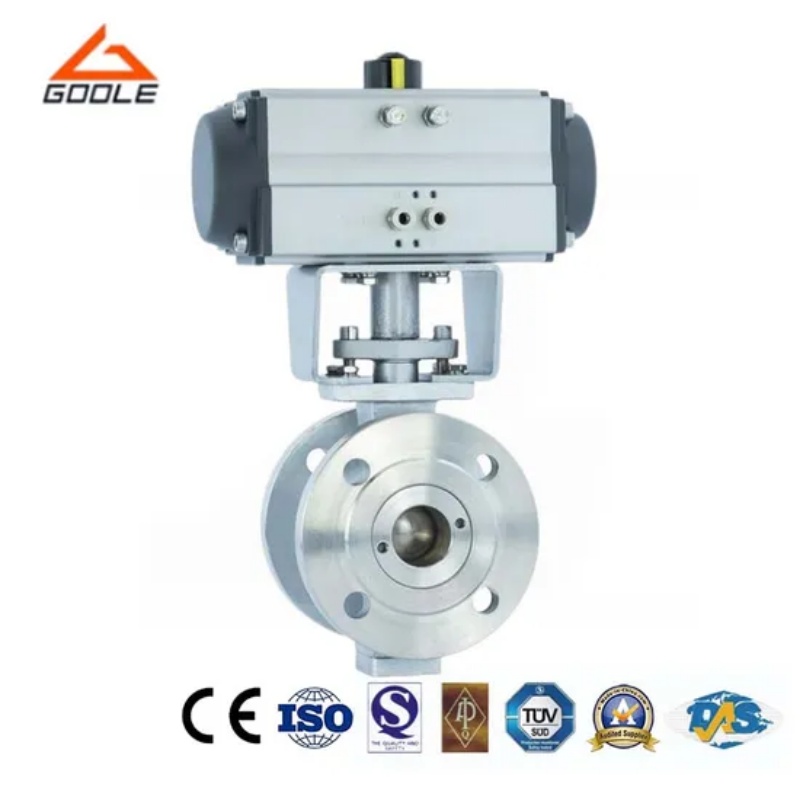
Pneumatic V type regulating ball valve VQ647H-16C
Pneumatic V Regulating Ball Valve VQ647H-16C Product Description
Pneumatic V regulating ball valve VQ647H-16C is designed for automatic cutting or process regulation needs in papermaking, chemical, mining, environmental protection, and industrial water treatment. When selecting, the composition of the medium, working temperature, maximum and normal flow rates, pressure before and after the valve, pipeline connection standards, operating frequency, and fault safety position should be checked first. The diameter cannot be directly applied based on the existing diameter. The parameters in this article are within the commonly used configuration range, and the final data should be based on the project operating conditions, technical confirmation form, and manufacturing drawings.
Product Specifications
| Product Model | VQ647H-16C |
| Structural form | Clamp connection, V notch ball core, metal or reinforced PTFE valve seat |
| Nominal Diameter | DN20-DN400 |
| pressure rating | PN16/PN25/PN40/PN64 |
| Valve body material | WCB/CF8/CF8M |
| sealing form | Metal hard seal or reinforced PTFE soft seal |
| Drive Type | Double acting or single acting pneumatic actuator |
| Applicable temperature | -29℃ to 300℃, confirm according to the valve seat material |
| Applicable Medium | Pulp, fiber suspension, powder particle mixed media, and general liquids |
Structure and working mode
The VQ647H-16C adopts a clamp connection and a V shaped notched ball core. The ball core is driven to rotate by a pneumatic actuator, changing the effective flow area, achieving flow regulation and cutting that meets sealing requirements. It does not undertake the flow path reversing function of a multi way ball valve. The actuator should be selected according to the operating torque under the maximum working pressure difference, and the output torque of the full opening and closing stroke should be verified. During continuous adjustment, the locator, control signal, and valve position feedback should be matched, and the single acting or double acting configuration and action requirements after gas loss should be clearly defined.
Caliber pressure and material
The commonly used nominal diameter is DN20-DN400, the pressure rating is PN16/PN25/PN40/PN64, and the valve body can be selected as WCB/CF8/CF8M. Material selection needs to consider corrosion resistance, chloride ion content, temperature cycling, medium cleanliness, and external environment simultaneously. The allowable temperature, pressure difference, and leakage level of metal hard seals or reinforced PTFE soft seals should be checked synchronously; The hardness, erosion allowance, and packing structure of the valve core and seat should also be confirmed for conditions involving particles, easy crystallization, or high-frequency operation.
Product Features and Applications
The main features of this product are shear self-cleaning, low flow resistance, and positioning adjustment. After reasonable configuration, it can be used in papermaking, chemical industry, mining, environmental protection, and industrial water treatment. The adjustment purpose needs to be combined with the flow characteristics and adjustable ratio to calculate the valve opening, while the cut-off purpose should focus on confirming the allowable leakage amount and action time. Dangerous areas should select actuators, locators, solenoid valves, and limit switches according to the on-site explosion-proof zoning; When dealing with highly corrosive, toxic, or flammable media, specialized material and safety reviews should also be conducted.
Installation and commissioning
Before installation, the nameplate, flow direction, flange or clamp standards should be checked, welding slag and hard debris in the pipeline should be removed, and the front and rear pipe sections should be concentric. It is forbidden to use valves to forcibly correct pipeline deviations. If configuring locators, solenoid valves, or limit switches, their electrical interfaces should be protected according to the on-site environment; The gas source should meet the requirements of the actuator and locator. For the first debugging, it is advisable to check the fully open and fully closed positions, travel feedback, interlock logic, sealing condition, and abnormal noise under low-risk conditions, and then gradually increase the working pressure.
operation and maintenance
During operation, action time, valve position feedback, leakage, pressure difference, and control signals should be recorded. If the action is slow, the air source, filtering and pressure reducing device, locator, solenoid valve, valve position feedback and pneumatic actuator should be checked first, and then the valve stem, valve seat and seals should be checked. It is not advisable to blindly increase the driving force. Before maintenance, it is necessary to isolate the medium, relieve pressure, and confirm that there is no residual energy; After replacing the seal, conduct strength, sealing, and action tests according to regulations, and record the material and maintenance date of the spare parts.
The corresponding electric V structure is shown inVQ947H-16C electric V type regulating ball valveSee more pneumatic ball valvesSelection of Pneumatic Ball Valve。
VQ647H-16C Pneumatic V Regulating Ball Valve Common Problems
Why can V ball valve be used for flow regulation?
The V shaped ball core changes the effective flow area during rotation and can therefore be used for adjustment, but the actual flow characteristics and adjustable range should be determined based on specific product data.
Can the clamp connection directly replace the flange V ball valve?
It is not enough to only look at the diameter, but also to verify the installation length, matching flange, valve body shape, pressure rating, and pipeline space.
Do pneumatic V ball valves need to be equipped with locators?
Corresponding positioning control configuration is usually required for continuous adjustment; Whether a locator is needed when only the switch is turned off depends on the control requirements.
Order Information List
Suggest providing the composition of the medium, design and operating temperature, maximum and normal pressure, flow range, pipeline standards, operating frequency, control signals, power or gas supply conditions, fail safe location, and environmental protection requirements. Fouten Flow Control (Jiangsu) Co., Ltd. will verify the caliber, material, seal, actuator, and accessory combination based on these materials to ensure that the product parameters are consistent with the actual pipeline conditions, and provide traceable basis for subsequent installation and maintenance.
 Home
 Valve selection
 news information
 Contact us