


 简体中文
 Japanese
 Korean
 Russian
 繁体中文
 Español
Valve selection
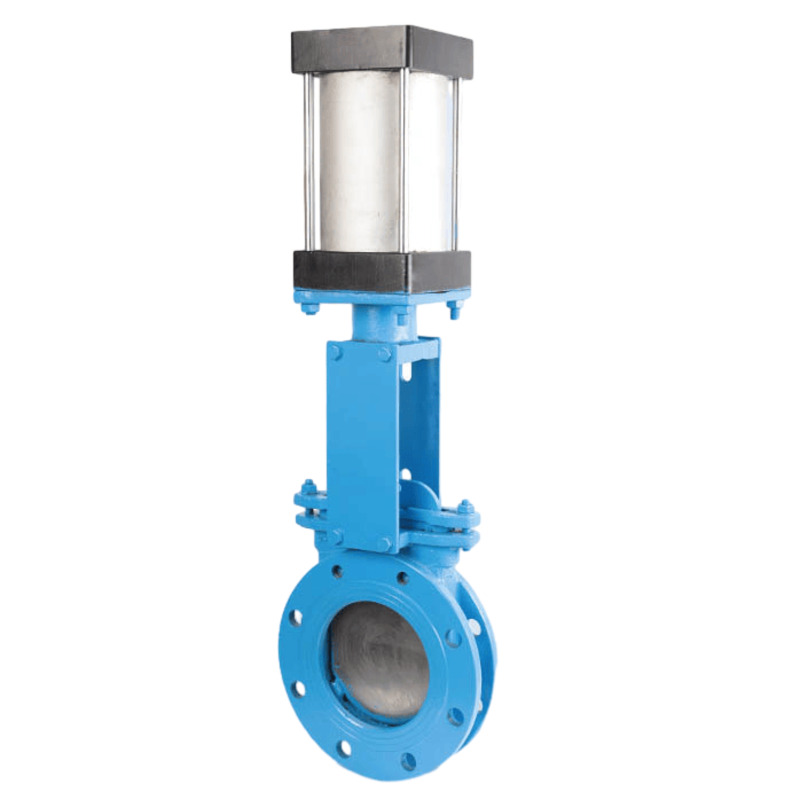
Pneumatic knife type gate valve PZ673H-16C
PZ673H-16C Pneumatic Knife Gate Valve
Product Specifications
| Product Model | PZ673H-16C |
| Structural form | wafer-type blade gate and pneumatic cylinder drive |
| Nominal Diameter | DN50-DN600 |
| pressure rating | PN10/PN16 |
| Valve body material | WCB/CF8/CF8M |
| sealing form | Metal hard seal |
| Drive Type | Double acting pneumatic actuator |
| Applicable temperature | -20℃ to 80℃ |
| Applicable Medium | Pulp, wastewater, and particulate media |
Product positioning
PZ673H-16C pneumatic knife type gate valve is used for opening, closing, and isolating fiber or particle containing media such as pulp, sewage, and slurry. The knife shaped gate moves linearly along the valve body guide when closed, which can cut off media with a large amount of suspended solids. Before specific application, the composition of the medium, particle size, fiber content, temperature, pressure, and pipeline layout should be checked to avoid determining the model only by name or appearance.
Structure and Action Principles
This type of valve usually adopts a wafer-type valve body, a knife type gate, and a double acting pneumatic actuator. Compressed air enters the actuator and drives the piston and valve stem, causing the gate to rise and fall and changing the opening and closing state of the channel. The air source pressure, actuator thrust, and valve diameter need to be matched; When it comes to interlocking or remote control, the solenoid valve, limit switch, air source processing component, and control signal interface should be confirmed simultaneously.
Caliber pressure and material
The commonly used caliber range can be selected from DN50 to DN600, and the pressure level can be confirmed according to working conditions such as PN10 or PN16. The valve body material can be selected from WCB, CF8, or CF8M. The actual material must be determined based on the corrosiveness of the medium, chloride ion content, temperature fluctuations, and environmental conditions. Metal hard seals are suitable for particle cutting scenarios, but leakage requirements, wear rates, and valve seat materials should still be clearly defined by project technical conditions.
Media and working condition verification
When used for pulp and wastewater, special attention should be paid to solid content, sedimentation trend, and valve operating frequency; When used in coal, chemical, or slurry systems, it is also necessary to confirm the abrasiveness, corrosiveness, and whether there is a risk of crystallization, adhesion, or flammability. If the temperature or pressure of the medium approaches the design boundary, or there is pressure pulsation, the valve technician should review it based on the pipeline grade and actuator thrust.
Pneumatic accessory configuration
The double acting pneumatic actuator is powered by a gas source in both the opening and closing directions, making it suitable for automatic control situations that require stable thrust and frequent movements. The gas source should be filtered, depressurized, and drained to maintain cleanliness and dryness. When gas loss protection is required, additional gas storage, spring reset scheme or upstream interlocking logic should be selected according to process safety requirements, and the definition of the fault position should be confirmed before debugging.
Installation key points
Before installation, the welding slag, hard particles, and other debris in the pipeline should be cleaned, and the flange or clamp connection surfaces at both ends should be checked for parallelism and coaxiality. There should be maintenance space for the actuator, pneumatic accessories, and packing parts near the valve to avoid stress transmission from the pipeline to the valve body. The connecting bolts should be uniformly tightened in the prescribed order, and the air pipes and cables should be securely fixed to prevent condensation or dust from entering the accessories.
Debugging and Running
For the first operation, it is advisable to check the fully open and fully closed positions and limit feedback under low-risk conditions, to confirm that the gas source pressure, action time, interlock signal are consistent with the on-site control logic. If there is loose closing, slow movement, abnormal noise or leakage during operation, the air source processing components, solenoid valves, actuators and valve stem guides should be checked first, and then the gate, seals and packing components should be checked according to the shutdown permit. Blindly increasing the air supply pressure is not allowed.
Maintenance Recommendations
Before maintenance, it is necessary to isolate the medium, relieve pressure, and confirm that there is no residual energy according to on-site safety regulations. During maintenance, the packing compression status, valve stem surface, gate wear, guide components, and connecting fasteners can be checked; When replacing vulnerable parts, the material, specifications, and date should be recorded. The inspection plan for systems containing particulate media should be developed based on the actual wear cycle, and spare parts should be retained if necessary to reduce downtime.
Selection Information
When ordering or technical confirmation, it is recommended to provide the medium name and composition, design and working temperature and pressure, maximum and normal flow rates, solid particle characteristics, pipeline standards, connection methods, operating frequency, gas source conditions, control signals, and fault safety requirements. Fouten Flow Control (Jiangsu) Co., Ltd. can be used to check the diameter, valve body material, sealing form, actuator and accessory combination, so that the valve configuration is consistent with the actual pipeline working conditions.
Acceptance Tips
On site acceptance can be carried out according to the project documents to check the appearance, connection dimensions, opening and closing actions, limit feedback, and sealing status. Any parameter adjustments, attachment replacements, or non-standard usage conditions should be documented in the equipment records for easy maintenance and traceability.
Common problems in product selection
PZ673H-16C is used for slurry with particles. What data is required?
Please provide particle size and hardness, solid content, fiber condition, medium composition, temperature, and working pressure difference to verify the gate, valve seat, and driving force. The blade structure does not mean that it can cut any hard particles, nor can the cylinder or electrical components be determined solely by the diameter.
Can PZ673H-16C be used to adjust the slurry flow rate for a long time?
It is not advisable to directly treat the cutting purpose as a continuous adjustment purpose. It is necessary to first evaluate the erosion, vibration, blockage, and sealing wear when half open; When there is a requirement for continuous adjustment, the applicable structure should be confirmed separately based on the flow rate and pressure difference.
PZ673H-16C needs to be turned off after gas interruption. How should the actuator be configured?
The safety position required for the process in case of gas loss should be clarified first, and then the single or double acting scheme, output force or torque, and accessory circuit should be checked. You cannot select cylinders based solely on valve diameter, nor can you assume that all pneumatic configurations will close when there is a loss of air.
 Home
 Valve selection
 news information
 Contact us