


 简体中文
 Japanese
 Korean
 Russian
 繁体中文
 Español
Valve selection
Can a fluoropolymer-lined regulating valve be used for acid containing particles? Corrosion resistance and wear resistance should be separated
Acid liquids containing particles have both chemical compatibility issues and issues of abrasion and blockage. Customers should provide particle size, hardness, content, and sedimentation conditions before selecting the lining and flow channel. It is not enough to simply write "corrosion resistance" to complete the selection.
Particle conditions cannot be based solely on one solid content percentage
Hardness, particle size distribution, sharpness, and sedimentation characteristics can affect sealing and lining. Fine and soft suspended solids and coarse and hard particles with the same solid content may cause different loads. Whether the medium crystallizes or forms hard deposits after shutdown should also be listed. If the procurement only states that the dilute acid contains a small amount of particles, the supplier may find it difficult to compare the flow, sealing, and lifespan, and may overlook the most unfavorable material batch.
The local flow states in the regulating zone and the fully open zone are different
The fluoropolymer-lined regulating valve changes the flow rate through the opening between the valve core and the valve seat, and a small opening and high pressure difference may cause particle concentration. When fully open, it can pass through, but it does not mean that long-term low flow regulation is also suitable. The passage space and protection method of different valve components may vary, and finished product data should be obtained. Ordinary lined ball valves cannot be upgraded to structures suitable for continuous adjustment with particles simply by adding valve positioners.
The ability to withstand media and temperature and pressure have their own boundaries
Particle abrasion may damage the isolation layer, allowing the metal to come into partial contact with the medium; Higher chemical resistance levels cannot independently prevent mechanical damage. Temperature, acid concentration, flow rate, pressure difference, and liquid contact combination should be evaluated together. The lining, valve seat, and packing may also reach the limit one after another. The selection should not be based on a more expensive fluoroplastic name to ensure lifespan, and the particle size should also correspond to the actual channel, opening, and solid characteristics. It is not possible to give values uniformly according to the acid solution name.
Let manufacturers compare solutions based on real working points
Provide normal and minimum flow rates, corresponding pressure differentials, medium composition temperatures, particle data, and opening and closing frequencies, and then compare fluoropolymer-lined single seat, other valve internals, or front-end solid management solutions. Adding filtration requires simultaneous verification of particle size distribution, allowable pressure drop, and blockage maintenance, and cannot solve all solid problems with just one filtration aperture. The acceptance requirements should specify the material, lining inspection, and flow control objectives, and the life evaluation should be based on actual working conditions rather than using the conclusions of clean water testing.
Comparison of selection information
| Information | Corresponding focus points |
|---|---|
| Chemical conditions | Concentration, temperature, and complete contact material |
| Solid conditions | Particle size, hardness, and sedimentation behavior |
| control conditions | Low flow opening and maximum regulating pressure difference |
Corresponding products and selection entrance
Treating acid solution as a combination of chemical composition and solid characteristics, rather than just a medium name, can improve the quality of selection data. Corrosion resistance, ability to pass through, and adjustment of wear resistance should be met separately in order to discuss long-term process control.
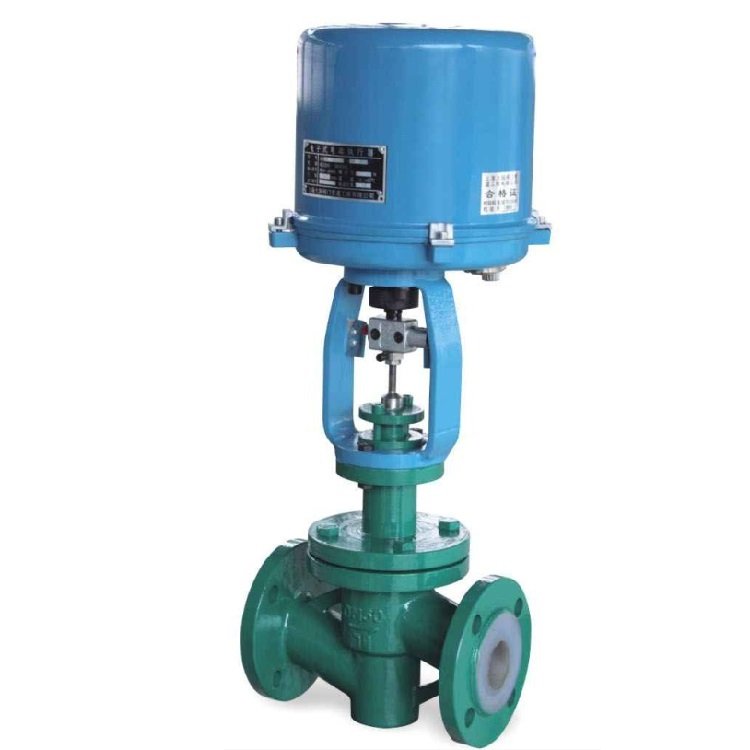
Related structures can be combinedZAZPF-16C electric fluoropolymer-lined single seat regulating valve (PFA/FEP/PTFE optional)Understanding of specific product information. See more similar directionsLining Valve Product Column。
Common customer questions
Does PFA's resistance to this acid mean it is also resistant to sand particles in the acid?
No, chemical compatibility does not equal resistance to mechanical abrasion. Both particle and flow state should be evaluated simultaneously.
Can fully open the particles and partially open them for adjustment?
Not necessarily, the throttle opening is different from the local velocity and needs to be compared according to the actual adjustment range.
Can adding a valve positioner to the fluoropolymer-lined ball valve adjust the acid containing particles?
It is not enough to rely solely on attachments to ensure that the ball core, valve seat, lining, and pressure difference are also suitable.
 Home
 Valve selection
 news information
 Contact us