


 简体中文
 Japanese
 Korean
 Russian
 繁体中文
 Español
Valve selection
Should I choose a fluoropolymer-lined plug valve or a ball valve for viscous media? View channels, residues, and drivers together
Choose a plug valve or ball valve for viscous media, and first check the flow channel, retention, temperature, and operating load. The ability of the pipeline to flow does not mean that it is easy to start after prolonged shutdown. Customers should explain the cleaning and shutdown status together.
Channel shape and internal retention are not the same indicator
Is the fully open channel sufficient and describe the main capacity of the medium to pass through; How much residue may remain after closing or switching depends on the internal cavity and actual geometry. Different plugs, spheres, and sealing structures have different characteristics, and it cannot be guaranteed that a certain valve type has no dead corners or is completely drained. If it is necessary to change batches, rinse or reduce residue, corresponding internal structure and evaluation data should be obtained, rather than just looking at the flange diameter.
Viscosity changes with temperature, and the shutdown state is particularly important
Normal hot state transportation is smoother, but it does not mean that the starting torque after cooling is the same. Crystallization, solidification, or adhesion may alter the sealing contact and rotational load. The operating condition table should include the conditions for operation, shutdown, and restart. Using a larger cylinder cannot independently solve material deposition, let alone exceed the allowable load of the valve stem and seal; Whether insulation or process changes are required is determined by professional design.
The lining material and control purpose are matched separately
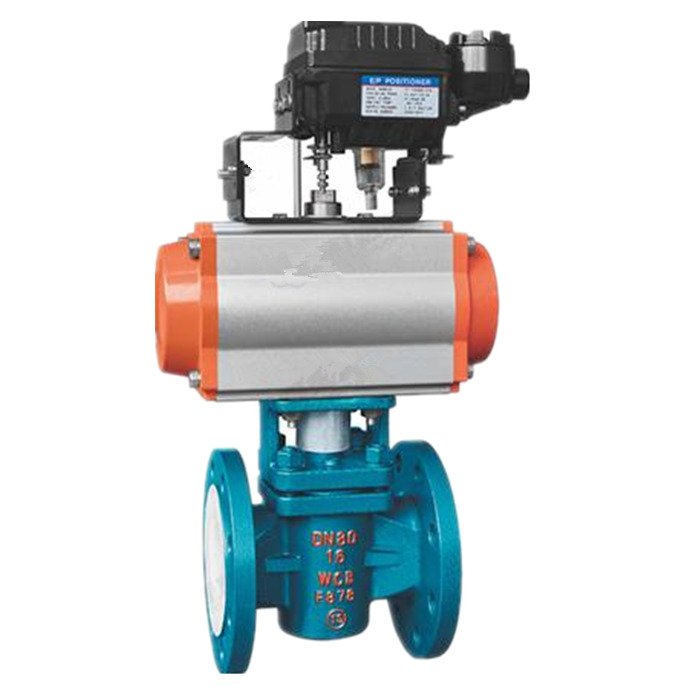
The XS643F46 pneumatic lining plug valve in the station has PFA and FEP directions, and the actual material should be consistent with the order. The configuration valve positioner can be used for valve position control, but it does not automatically prove to be suitable for continuous adjustment of all viscous media. Ball valves also need to be matched with valve seats, flow paths, and pressure differentials. The selection should specify the tasks of cutting off, reversing, or continuous adjustment separately, and cannot transfer the ability of one use to another.
When comparing schemes, use the same set of operating conditions and residual requirements
Inquiry should provide information on viscosity and temperature relationship, solid content or crystallization situation, flow pressure difference, downtime, cleaning solution and allowable residue. Compare the liquid receiving materials, channels, structural length, driving force, and matching control. When the testing medium and load of different products are inconsistent, it is not advisable to directly rank them by action time or promotional characteristics. Technical review should focus on the most unfavorable conditions, rather than just the easy working conditions during normal transportation.
Comparison of selection information
| Information | Corresponding focus points |
|---|---|
| task | Distinguish between cutting, reversing, and continuous adjustment |
| medium | Provide viscosity temperature and shutdown changes |
| structure | Comparison of main channels and retention |
Corresponding products and selection entrance
The key to selecting viscous media is the ability to pass, remain, and move under complete operating conditions, rather than the ranking of valve types. Comparing the same data with different structures is necessary to obtain meaningful selection conclusions.
Related structures can be combinedSteel lined fluoropolymer pneumatic flange plug valve with valve positioner adjustmentandPneumatic steel lined fluoropolymer flange ball valveUnderstanding of specific product information. See more similar directionsLining Valve Product Column。
Common customer questions
Is it certain that fluoropolymer-lined plug valves have less residue than ball valves?
It is not possible to make a general judgment, and specific internal geometry and actual cleaning conditions need to be compared.
Can a fluoropolymer-lined plug valve with a valve positioner be precisely adjusted?
Not necessarily, valve position control is different from flow characteristics and throttling applicability, and requires finished product data.
Is it enough to simply increase the cylinder when the viscosity is high?
Not enough, channel, sedimentation, temperature, and allowable mechanical load should be evaluated simultaneously.
 Home
 Valve selection
 news information
 Contact us