


 简体中文
 Japanese
 Korean
 Russian
 繁体中文
 Español
Valve selection
What is the difference between fluoropolymer-lined valve penetration and chemical corrosion? We can't just check the chemical resistance list
Chemical resistance and medium penetration are different issues. The lining material is compatible with the medium and still needs to be evaluated for temperature pressure, structure, and permeability management; Customers can write down the operation and shutdown process clearly, which is more complete than just checking one acid resistance meter.
Chemical stability and barrier ability are not the same property
The chemical resistance table mainly helps to determine the compatibility of materials under corresponding medium conditions, and cannot independently describe all permeation behaviors. Components can still be affected by diffusion and pressure conditions without significant surface chemical damage. The complete valve also involves the thickness of the lining layer, fixing and liquid contact structure. Therefore, relying solely on the name of the resin and a statement about acid resistance cannot prove the actual long-term protective performance.
Temperature and medium state can change long-term conditions
Temperature, concentration, volatility, and operating duration may all affect the interaction between the lining and the medium. Shutdown, cleaning, and pressure changes also need to be included in the process, rather than just looking at static conditions at room temperature. Penetration evaluation should use data corresponding to the material, thickness, and medium state, and the specific lining layer should also consider the forming and fixing structure. It is not possible to infer the same barrier capability between different configurations by changing the material name.
Pinholes, scratches, and penetrations need to be identified separately
Local defects may form direct contact channels, while material penetration may not necessarily manifest as visible pinholes. The inspection evidence and improvement direction of the two are different. There is no visible damage on the surface, which cannot prove that the barrier ability is fully satisfied; Defects detected should not be broadly interpreted as materials that are not resistant to media. Abnormalities in hazardous processes should be evaluated by professionals according to safety procedures and finished product structure, and cannot be judged on-site based on a single photo.
Procurement emphasizes complete liquid contact path and long-term working conditions
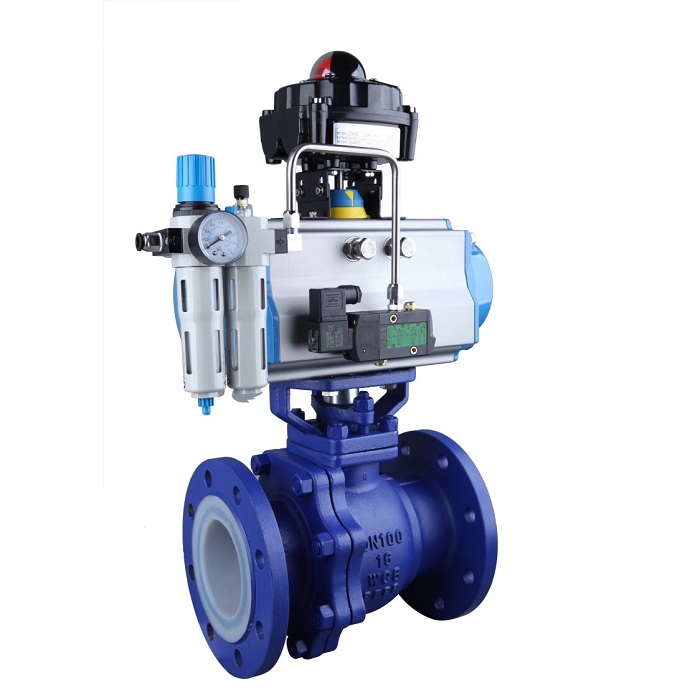
For pneumatic lined ball valves such as Q641F46/PFA, the actual configuration of PFA or FEP should be clearly defined, and the ball, valve seat, valve stem, and connecting end face should be covered. The working condition data should include the composition, concentration, temperature process, pressure, and cleaning conditions of the medium. If necessary, the manufacturer is required to explain the corresponding permeation and lining structure basis. The chemical resistance table, finished product inspection, and operating conditions complement each other and cannot be replaced.
Comparison of selection information
| Information | Corresponding focus points |
|---|---|
| material | Evaluate compatibility and barrier behavior separately |
| Defect | Pinholes, mechanical injuries, and infiltration are not mixed |
| Operating condition | Including temperature process and cleaning stage |
Corresponding products and selection entrance
The selection of fluorine lining extends the problem from material durability to how the medium acts on the complete lining layer, which can make engineering discussions more accurate. The goal is to obtain a matching finished product structure and operating conditions, rather than searching for a material slogan that covers all working conditions.
Related structures can be combinedPneumatic steel lined fluoropolymer flange ball valveUnderstanding of specific product information. See more similar directionsLining Valve Product Column。
Common customer questions
Does PFA acid resistant mean that there will be no infiltration at all?
It cannot be directly inferred that chemical compatibility and barrier properties are different, and corresponding media and structural data are required.
Does the absence of scratches on the surface of the lining indicate that long-term protection is definitely qualified?
It is not enough to rely solely on appearance proof, materials, structures, corresponding inspections, and working conditions are still required.
Can FEP and PFA be replaced solely based on resin prices?
Not suitable, the forming structure, medium, temperature, and complete contact material should also be compared.
 Home
 Valve selection
 news information
 Contact us