


 简体中文
 Japanese
 Korean
 Russian
 繁体中文
 Español
Valve selection
Why are the drives of pneumatic gate valves and pneumatic ball valves different? Thrust, torque, and stroke
Gate valves require corresponding linear travel and thrust, while ball valves typically require partial rotation and torque. Before selecting a pneumatic drive, confirm the motion and load first, and then discuss the interface and accessories. They cannot be interchanged just because the gas supply is the same.
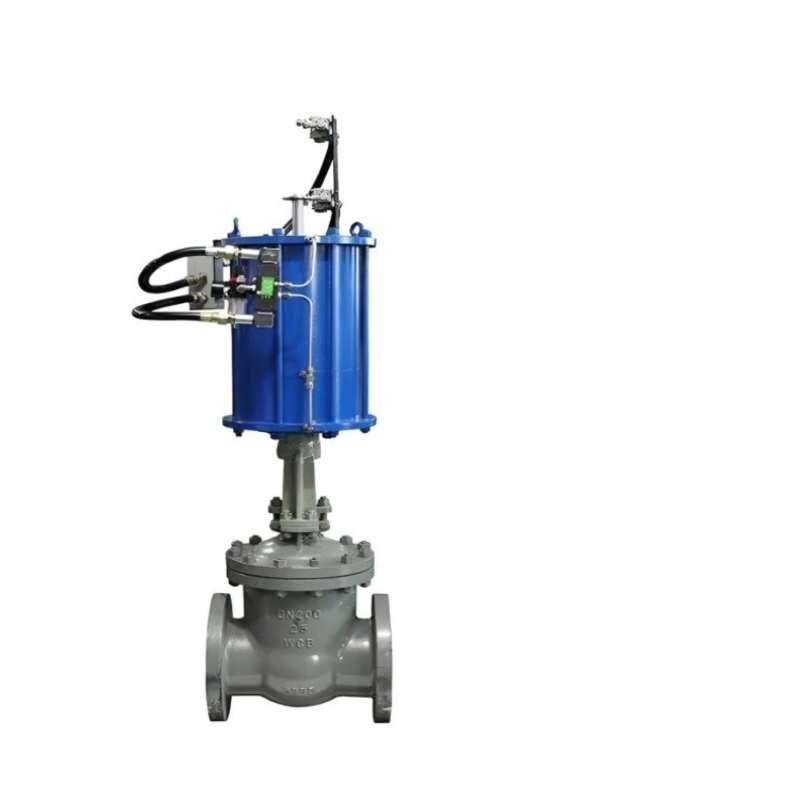
First, identify the output form of the motion recognition of the opening and closing components
The gate can leave or enter the main flow channel by lifting and lowering, and the actuator should provide linear motion that matches the valve stem mechanism; Rotating a sphere requires angular travel output. The drive with a conversion mechanism can change the output form, but its efficiency, support, and stroke also need to be incorporated into the design. It is not possible to directly move cylinders with similar appearances to another valve body, nor can the connection requirements be considered the same solely based on the word 'pneumatic'.
Thrust and torque are not directly comparable numbers
The straight stroke drive overcomes the medium load, sealing contact, and mechanism friction with force; Rotary drive uses torque to overcome starting torque and resistance during travel. The two have different units and geometric relationships. Even if converted by levers or transmission components, actual dimensions and efficiency must be used. Comparing numerical values directly in procurement can easily overlook units and institutions, making seemingly larger output solutions unsuitable for the original valve.
Turn on, run, and turn off, the load is not a constant
The pressure, guidance, and sealing status of the gate valve will change the operating load; The starting and end friction of ball valves may also differ from the intermediate stroke. The output curve of the actuator is also affected by the gas source, spring, and transmission mode, so it is necessary to compare the available outputs at each key position. Only checking the maximum output of the cylinder cannot indicate whether the most unfavorable position has sufficient capacity. Fault reset should be evaluated based on the corresponding travel load.
The installation space and control accessories are also different
Gate valves need to accommodate linear travel and upper components, while ball valves need to be suitable for rotary mechanisms and connecting brackets. The feedback device should reflect the actual position of the movement, and manual emergency mechanisms cannot assume the same operating mode. The replacement project should provide the valve body size, valve stem connection, stroke or angle, operating load, and gas source at the same time. Automation transformation is not just adding an electromagnetic valve, but completing the coordination between structure and control.
Comparison of selection information
| Information | Corresponding focus points |
|---|---|
| form of exercise | Distinguish between lifting, rotating, and conversion mechanisms |
| Output capability | Compare thrust or torque and curves separately |
| Interface space | Check the connection, travel envelope, and support |
Corresponding products and selection entrance
Write thrust and stroke when inquiring about pneumatic gate valves, torque and angle when inquiring about pneumatic ball valves, and then add the actual load and minimum gas source. This can enable the comparison of drivers to be based on the same technical conditions, avoiding mistaking differences in valve types for brand differences.
Related structures can be combinedPneumatic gate valve Z641H-16CandPneumatic flange ball valve Q641F-16CUnderstanding of specific product information. See more similar directionsPneumatic Valve Product Column。
Common customer questions
Can the angular stroke cylinder of the pneumatic ball valve be directly installed on the pneumatic gate valve?
Usually cannot be directly replaced. Opening and closing movements are different from connections and require matching output forms or specialized conversion designs.
Is an actuator with high thrust necessarily stronger than a cylinder with high torque?
The units and forms of action of the two are different and cannot be directly sorted. They should be calculated according to the corresponding valve load.
Can two valves DN be matched with cylinders of the same specifications?
It cannot be decided solely by DN. The internal structure, pressure difference, sealing, and stroke load of the valve will all change the driving requirements.
 Home
 Valve selection
 news information
 Contact us