


 简体中文
 Japanese
 Korean
 Russian
 繁体中文
 Español
Valve selection
Can the adjustable ratio of the regulating valve be adjusted stably from zero flow? Inherent and installation scope
A larger inherent adjustable ratio does not mean stable control from zero flow to peak flow. The customer provides both low load and pipeline conditions, and then evaluates the actual opening range, not just comparing a ratio on the sample.
The inherent adjustability ratio is first associated with the flow capacity of the valve
Inherent adjustability typically involves the boundary between the maximum and minimum controllable flow coefficients and characteristic deviations under specified conditions. Different manufacturers may use different criteria for data, and when comparing, definitions, test conditions, and corresponding valve internals should be obtained, rather than just comparing numerical sizes. The valve body DN may have different capacities and characteristics due to different valve internals.
The flow coefficient describes the flow capacity under corresponding conditions, not the actual flow rate under any operating condition. After changes in density, medium state, and valve pressure difference, the flow rate at the same opening may vary. Therefore, when evaluating finished products using inherent indicators, it is necessary to retain their applicable conditions and not directly convert them into the production load range of the device.
After installation in the pipeline network, the pressure difference and system characteristics will change
The actual available pressure difference of the valve is determined by the pump, other resistance, and process pressure. When the load changes, these conditions may not remain unchanged, and the flow characteristics after installation may differ from the curve under fixed pressure difference. The evaluation system's available adjustment range should analyze valves and pipelines in the same model or operating data.
The stable control under minimum load is also affected by measurement signals, drive response, and process requirements. The fact that a valve can generate a small flow rate does not mean that the system can accurately measure and maintain it stably for a long time. Should the customer specify whether they require a minimum continuous load, short-term transition, or cessation of material supply; These three tasks may adopt different approaches.
Complete closure and minimum stability adjustment are two types of boundaries
Allow valve seat leakage when closed, evaluate cut-off status; Evaluate the regulation status based on the minimum controllable flow coefficient or actual minimum stable flow rate. Two sets of data cannot replace each other. Strict leakage level does not necessarily mean good continuous adjustment when approaching closure, and a larger adjustable ratio does not necessarily mean complete closure without leakage.
If the process requires zero feed and very low continuous flow, the acceptance conditions for cutting off and adjusting should be clearly defined. The necessary isolation or other system arrangements are confirmed by the design, and cannot cover all tasks by writing the adjustable ratio as infinitely large, nor should a near closed position that cannot be stably maintained be considered as a normal long-term operating point.
The structure provides regulatory capabilities, but the entire response still needs to be verified
The V ball core and other structures change the effective flow area through opening changes, but the actual usable range still needs to correspond to the characteristics of the finished product, driving friction, and positioning ability. The signal resolution is very high, which does not mean that even small changes can be accurately converted into the movement of the opening and closing components; The coordination between the locator and the actuator should also be evaluated under the specified load.
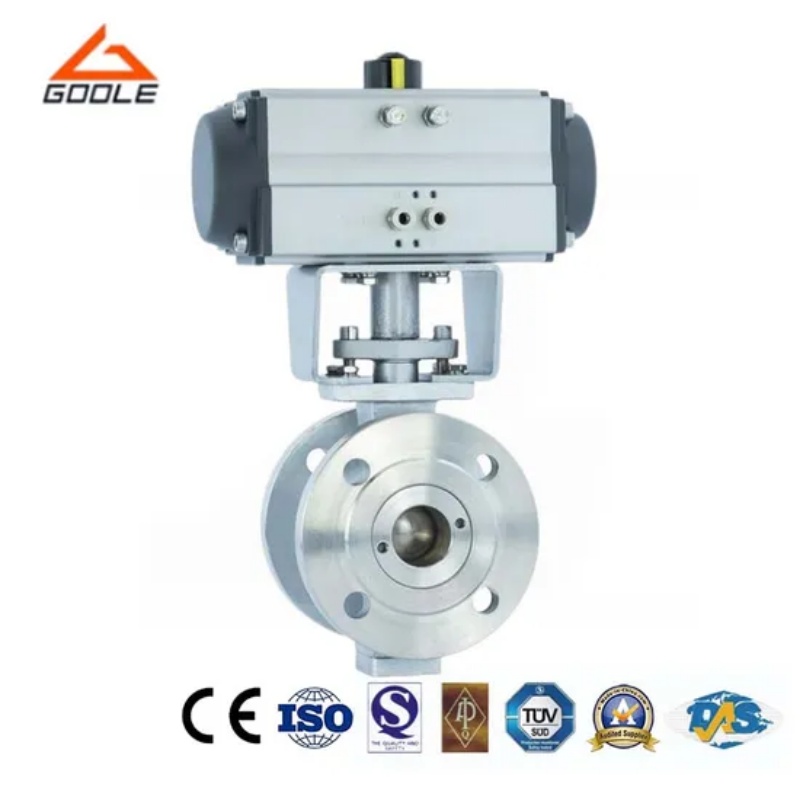
The VQ647H-16C pneumatic V regulating ball valve of Fouten can be used for corresponding continuous regulation tasks. The specific flow characteristics and adjustable range are checked according to the valve internals and configuration. The V type name is not a universal adjustable ratio value. The inquiry should list the maximum, normal, and minimum stable requirements separately in order to determine whether a certain specification is suitable.
Evidence of retaining different loads for selection and acceptance
Procurement provides flow rates, pressure before and after valves, medium conditions, and allowable fluctuations for each load point, and then obtains corresponding opening and flow coefficient evaluations. Don't just confirm that peak traffic can pass and ignore long-term low load conditions; Do not reduce specifications without calculation and lose high load capacity for low flow control.
On site evaluation records setting, feedback, actual flow and pressure difference, observing whether changes are stable and reproducible. The tests used for comparison should have clear time periods and load conditions, and not use a single instantaneous reading as proof of long-term control. Both the supply and demand sides use the same definition for acceptance, which can reduce disputes over adjustable parameters that are high but not easy to use.
Adjustable Range Checklist
| indicator | Corresponding information is required |
|---|---|
| Inherent adjustable ratio | Definition, criteria, test conditions, and valve internals |
| Installation scope | Actual pressure difference and system characteristics under different loads |
| Minimum Stable Requirement | Continuous flow, allowable fluctuation, and measurement capability |
| Close Request | Independently allowing leakage and cutting off tasks |
| Complete response set | Real valve position, load, and positioning control performance |
Corresponding products and further selection
Adjustable ratio should be used as defined and conditional performance information. Checking the inherent indicators, installation range of the pipeline network, minimum stable load, and closure requirements separately is more conducive to obtaining a truly usable regulation plan than pursuing only a larger proportion.
Can be combinedPneumatic V type regulating ball valve VQ647H-16CThe actual product information confirms the structure and selection requirements. For more similar products, please refer toPneumatic Valve Column。
Related questions can continue to be read:How to understand the flow characteristics of regulating valves Cv, Kv?。
General principle reference:Valmet Inherent and Adjustable Installation Ratio ExplanationThe specific functions of the finished product are based on the corresponding structure and verification data.
Common customer questions
Can the adjustable ratio 100 ensure 1% of the maximum flow rate on site compared to 1?
We cannot guarantee based solely on proportion. It is necessary to verify the definition of indicators, actual pressure difference, measurement, and complete response. The available range after installation may vary.
Class VI is well sealed, is low opening adjustment always good?
The two evaluate different tasks. The leakage level of the valve seat cannot replace the verification of minimum stable regulation and dynamic response.
Do you not need to check the minimum flow rate when choosing the V ball valve?
Still need to be verified. The V structure has a corresponding adjustment basis, but the available range is determined by the characteristics of the finished product, actual pressure difference, drive and positioning configuration.
 Home
 Valve selection
 news information
 Contact us