


 简体中文
 Japanese
 Korean
 Russian
 繁体中文
 Español
Valve selection
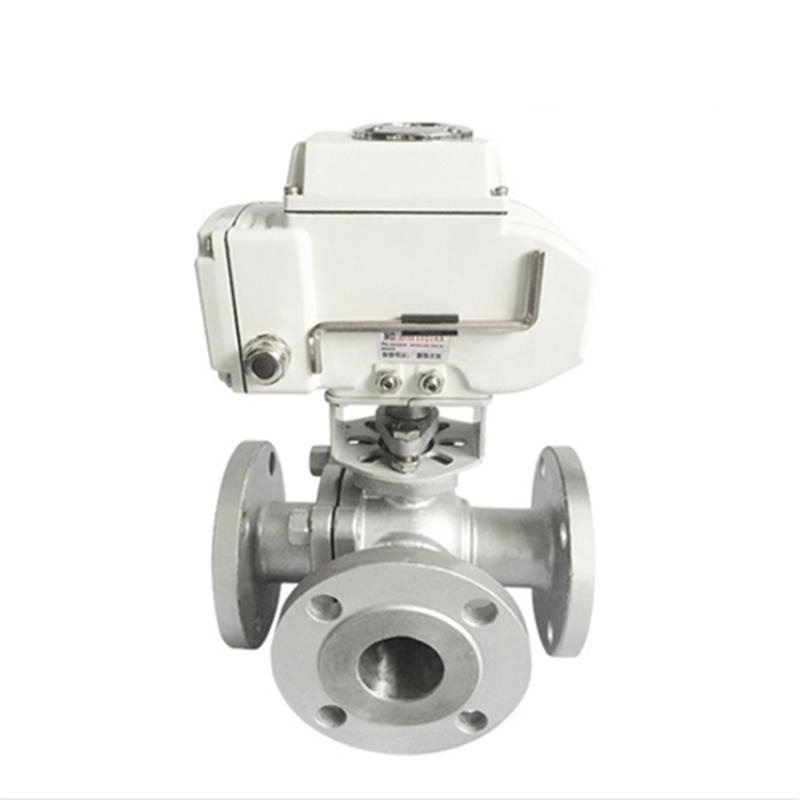
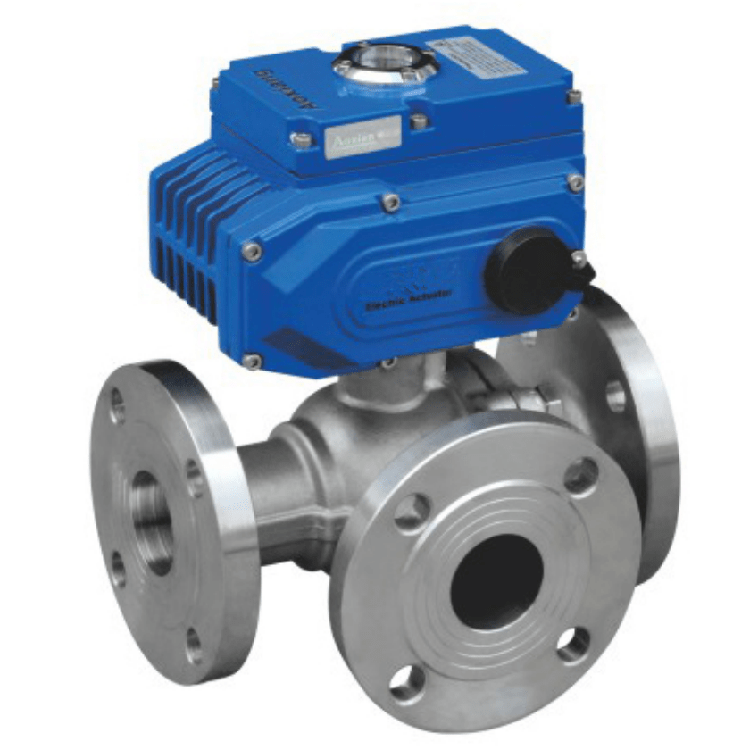
Electric Three-Way Ball Valve Q945F-16P
| Specification | Value |
|---|---|
| Model number | Q945F-16P |
| Specification and caliber | DN15-DN200 |
| Pressure level | PN16/PN25 |
| Material | CF8/CF8M |
| Product Features | Three-way diverter and converger, T-type flow path, remote control |
Electric Three-Way Ball Valve Q945F-16P Product Description
The Q945F-16P electric three-way ball valve is designed for process diverging, circulating bypass, water treatment, and automation applications requiring automatic switching or process control. The hole type, angle, and common port position determine the flow paths for each working position. When the equipment needs to switch for backflow, discharge, or cleaning, drawing these positions on the same flow path chart helps in selecting the ball core and position feedback.
Product Parameters
| Product Model | Q945F-16P |
| Structure Type | T-type three-way flow path, flanged connection, floating ball structure |
| Nominal Diameter | DN15-DN200 |
| Pressure Rating | PN16/PN25 |
| Body Material | CF8/CF8M |
| Sealing Type | PTFE or reinforced PTFE soft seal |
| Actuation Method | Quarter-turn electric actuator |
| Applicable Temperature | -20â to 180â, confirmed by sealing material |
| Applicable Media | Water, oils, gases, and compatible process media |
Structure and Working Method
The Q945F-16P adopts a T-type three-way flow path, flanged connection, and floating ball structure. As the fluid flows through the valve body, the quarter-turn electric actuator changes the position of the opening and closing element, thus completing diverging, converging, and switching according to the designed flow path; if continuous proportional adjustment is required, the ball core flow path and control configuration should be verified separately. The actuator should match the torque or thrust required by the valve and leave a reasonable safety factor. When feedback, positioning, or interlocking requirements are present, it is necessary to specify the power supply, control signal, valve position feedback, and electric actuator requirements during the ordering phase to avoid inconsistencies in field accessory interfaces.
Diameter, Pressure, and Material Selection
The commonly used diameters are DN15-DN200, and the pressure ratings are PN16/PN25. The valve body material can be selected as CF8/CF8M, but the material selection should consider the corrosiveness of the medium, chloride ion content, temperature fluctuations, and cleaning conditions. PTFE or reinforced PTFE soft seals require simultaneous verification of allowable temperature, pressure differential, and leakage levels. For steam, easily crystallizing, particulate-containing, or frequently actuated conditions, further confirmation of the hardness of internal components, packing type, and anti-erosion measures is necessary.
Product Features and Applicable Industries
The main features of this product are three-way diverging and converging, T-type flow path, and remote control. After reasonable configuration, it can be used for process diverging, circulating bypass, water treatment, and automation applications. When used in hazardous areas, the corresponding actuators, solenoid valves, limit switches, or positioners should be selected according to the site explosion-proof zoning; for systems in food, pharmaceutical, etc., the liquid contact materials, surface treatment, and cleaning requirements must also be confirmed. Any projects involving oxygen, strong corrosives, or toxic media should undergo specialized material and safety reviews.
Installation and Commissioning
Before installation, check the nameplate, flow direction, flange or thread standards, remove welding slag and hard debris from the pipeline, and ensure that the upstream and downstream pipe sections are concentric to avoid transmitting pipeline stress to the valve body. Sufficient disassembly space should be reserved around the actuator, and the cable entry should be waterproofed and protected according to the site environment. The initial commissioning should check the fully open and closed positions, stroke feedback, interlocking logic, and sealing conditions under low-risk conditions before gradually entering working pressure.
Operation and Maintenance
During operation, observe action time, abnormal noise, external leaks, valve position feedback, and control signals. If the action is slow, first check the power supply, wiring, control module, valve position feedback, and electric actuator, then check the valve stem, seat, and sealing elements, and avoid blindly increasing the driving force. Before maintenance, the medium must be isolated, depressurized, and confirmed that the equipment has no residual energy. After replacing sealing elements, strength, sealing, and action tests should be conducted as per regulations, and the material of spare parts and maintenance dates should be recorded.
The L-type switching structure can be found in Electric L-Type Three-Way Ball Valve (Q944F-16P); for more electric ball valves, see Electric Ball Valve Selection.
Common Questions about Q945F-16P Electric T-Type Three-Way Ball Valve
What is the main function of the T-type three-way ball valve?
The T-type flow path can be designed for diverging, converging, or different interface combinations based on the valve position; the actual connection relationships should be clarified at the time of ordering.
What are the main differences between Q945F-16P and Q944F-16P?
The Q945F-16P features a T-type flow path, while the Q944F-16P series documentation features an L-type flow path; the two should be selected based on the required flow path combination.
Does the T-type three-way ball valve default support 4â20mA proportional adjustment?
No, it only applies if the actuator and control module are explicitly configured with the corresponding adjustment function.
Ordering Information Checklist
It is recommended to provide medium composition, design and working temperature, maximum and normal pressure, flow range, pipeline standards, action frequency, power supply, control signal, valve position feedback, and electric actuator requirements along with environmental protection requirements. Fouten Fluid Control (Jiangsu) Co., Ltd. will verify the valve diameter, material, sealing, actuator, and accessory combinations based on this information to ensure that product parameters align with actual pipeline conditions and provide traceable references for subsequent installation and maintenance.
 Home
 Valve selection
 news information
 Contact us