


 简体中文
 Japanese
 Korean
 Russian
 繁体中文
 Español
Cv and Kv describe flow capacity under specified reference conditions, not valve quality. Start control valve sizing with the minimum, normal and maximum flow rates and the pressure drop at each operating point. Then check the required capacity, usable travel and flow characteristic instead of selecting a valve by pipe size alone.
Use the control valve selection guide for the overall process. Capacity, valve trim and actuation are related decisions, but none replaces the other two.
What do Cv and Kv mean?
Both are flow coefficients used to compare capacity under defined conditions. They do not specify pressure rating, leakage class, control accuracy or service life. The reference units and conditions must be known before comparing two published values.
| Check | Cv | Kv |
|---|---|---|
| Reference flow | Common US Cv uses US gallons per minute of water at the stated reference conditions | Cubic metres per hour of water at the stated reference conditions |
| Reference pressure drop | 1 psi | 1 bar |
| Unit-system check | Distinguish US gallons from Imperial gallons | Check the water reference temperature used by the data source |
| Meaning | A capacity coefficient, not a universal flow rate or a performance score | |
When the coefficient is explicitly US Cv, a common conversion is Cv (US) ≈ 1.156 × Kv, or Kv ≈ 0.865 × Cv (US). Do not apply these factors to Imperial-gallon Cv. This is a unit conversion, not a universal sizing equation for gas, steam, viscous liquids or two-phase flow. See the Spirax Sarco capacity definitions for the reference systems.
Why is a larger coefficient not always better?
An oversized valve can operate close to its seat during normal duty, leaving a narrower useful travel range and making small flow changes harder to manage. An undersized valve may fail to deliver the required maximum flow or operate too close to full travel. These outcomes depend on the actual pressure drop and control loop; adding unlimited capacity is not a substitute for sizing.
The same DN can contain different trim sizes, flow passages and rated coefficients. Check capacity against each operating point rather than assuming that a valve matching the pipe diameter will control well.
Linear, equal-percentage and quick-opening characteristics
These describe inherent valve behaviour under specified pressure-drop conditions. They are not guarantees of the flow response after installation in a particular pipe system.
| Characteristic | Basic meaning | Selection check |
|---|---|---|
| Linear | Similar travel increments produce approximately equal coefficient increments | Check how pressure drop changes across the operating range |
| Equal percentage | Similar travel increments produce approximately equal percentage changes in the coefficient | Evaluate the installed system rather than assuming it is always preferable |
| Quick opening | Capacity increases strongly at relatively small travel | Useful for certain duties, not the default for every continuously modulating service |
A valve at 50% travel does not necessarily deliver 50% of the pipe system's maximum flow. Inherent characteristics concern the valve itself; installed characteristics also reflect pipe resistance, equipment pressure losses and changing valve differential pressure. The distinction is explained in Spirax Sarco's control valve characteristics guide.
What does rangeability tell the buyer?
Rangeability relates the maximum and minimum controllable flows under stated conditions. It is not a promise of stable control down to zero flow. Trim, pressure conditions, fluid properties, actuation and feedback all matter to the installed result. Do not assign one fixed ratio to every valve model.
When does capacity sizing need additional engineering checks?
High liquid pressure drops or pressures approaching the liquid's vapour pressure can require cavitation or flashing evaluation. High pressure drops in gas service can require checks on noise, velocity and other flow limitations. Particles, viscosity and changing fluid conditions also affect selection. A Cv/Kv number alone does not establish safe operation or trim life.
What information should I send for sizing?
- Medium and phase, temperature and relevant physical properties.
- Minimum, normal and maximum flow, with consistent units.
- Upstream and downstream pressures and the differential pressure at the relevant duties.
- Pipe size, connection details and permitted pressure loss.
- Required characteristic, operating range and shut-off leakage requirements.
- Body and trim materials, actuator, control signal and required failure position.
Incomplete data should lead to clearly identified follow-up checks, not an unsupported valve-size commitment. Confirm whether quoted pressures are absolute or gauge and keep the same basis throughout the calculation.
From capacity to a real valve configuration
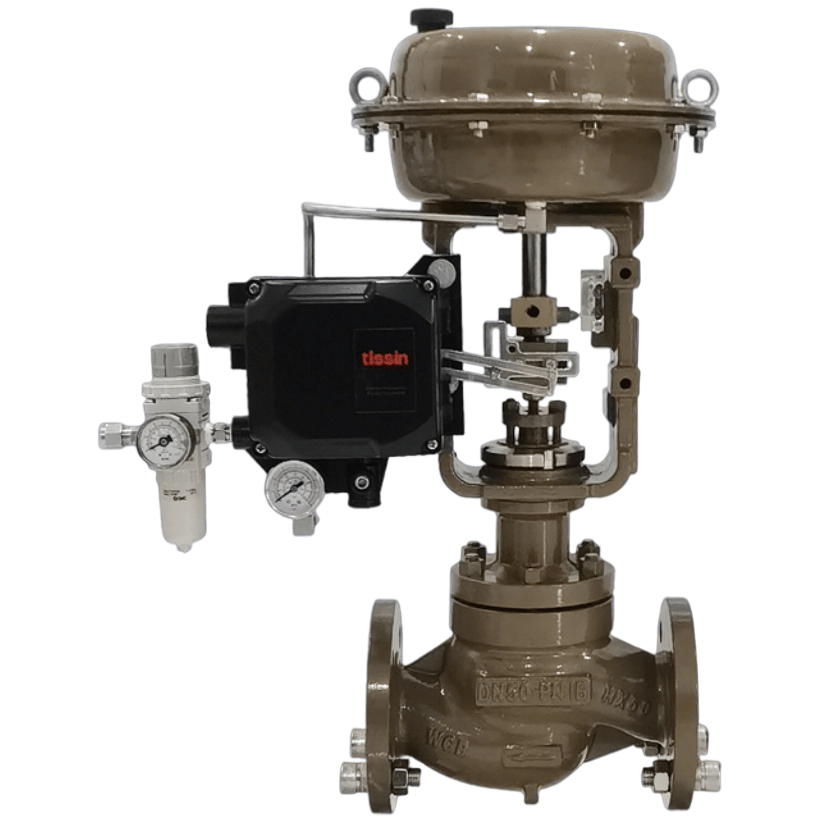
Representative products include the ZJHP-16C pneumatic single-seated control valve, pneumatic straight-through cage control valve and ZDLP electric single-seated control valve. Use each product's actual data; do not transfer one model's limits to another.
Next compare single-seated and cage-guided trim, then choose pneumatic or electric actuation for the site's energy supply, control interfaces and failure requirements.
 Home
 Valve selection
 news information
 Contact us