


 简体中文
 Japanese
 Korean
 Russian
 繁体中文
 Español
Choose single-seated or cage-guided trim by the shut-off requirement, pressure drop, flow range and medium, not by assuming that one construction is more advanced. A cage does not automatically provide low noise or anti-cavitation performance, and a single seat does not automatically provide lower leakage. The actual trim design and acceptance conditions decide.
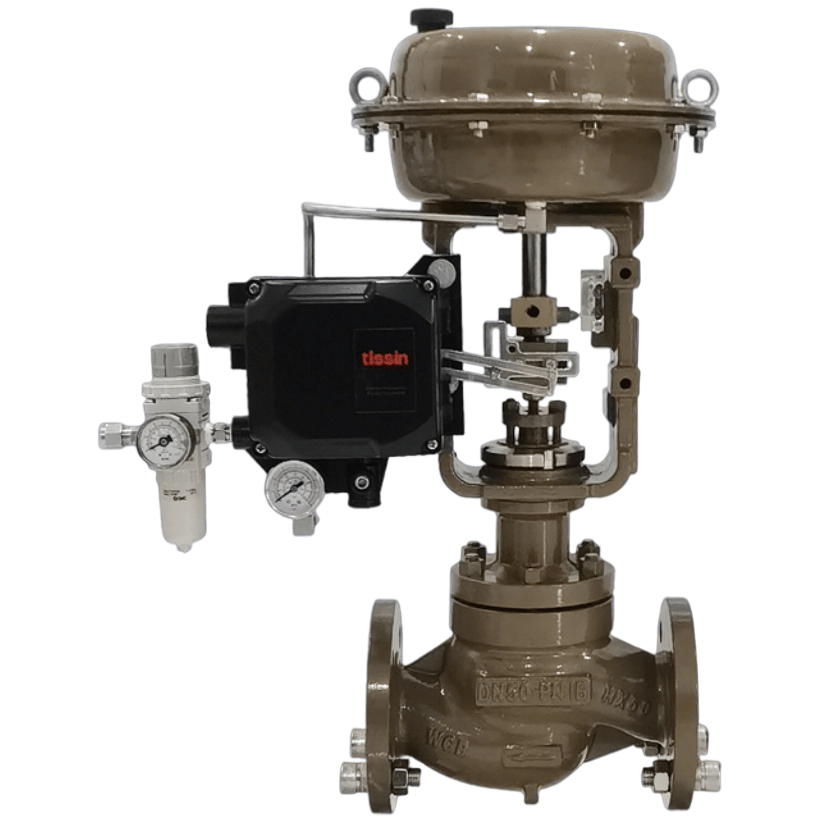
The control valve selection guide provides the overall framework. This comparison concerns valve internals; pneumatic and electric actuation are a separate selection dimension.
What are single-seated and cage-guided control valves?
A single-seated valve generally has one main plug-and-seat flow path and a defined shut-off sealing interface. Its performance also depends on guidance, sealing materials and the selected actuator.
Cage-style trim uses a cage or sleeve as part of the throttling and guiding arrangement. Depending on the design, windows, holes, balanced plugs or specialised trim may manage flow, loading or pressure reduction. Not every cage valve has multi-stage pressure reduction, low-noise trim or the same flow capacity.
Construction and maintenance comparison
| Item | Single-seated construction | Cage-style construction |
|---|---|---|
| Main trim | Plug and seat arrangement | Plug with cage or sleeve arrangement |
| Guidance | Depends on the specific design | Often uses the cage for plug guidance |
| Throttling | Controlled opening between plug and seat | May use cage windows or passages |
| Maintenance focus | Plug, seat, sealing surfaces and packing | Plug, cage, seat, guiding surfaces and packing |
This is a construction comparison, not a universal ranking of precision, leakage, capacity or maintenance cost.
Which construction can handle a higher differential pressure?
Some cage-guided designs use stable guidance, pressure balancing or specialised trim to manage particular loads and erosion or noise risks. A single-seated design is not automatically unsuitable for high differential pressure. Review the trim arrangement, balancing method, medium, size, operating pressures and available actuator thrust together.
Balanced trim can change the load on the actuator, but it also introduces design-specific sealing considerations. Do not apply a capability from one balanced cage product to every cage valve. General valve and actuator principles are covered in the Emerson Control Valve Handbook.
Which one provides tighter shut-off?
Check seat form, sealing materials, trim design, actuator thrust and the specified leakage acceptance. Neither construction name establishes zero leakage. Agree the test medium, pressure conditions and applicable leakage requirement rather than comparing labels alone.
Does a cage valve always have greater capacity?
No. Body passages, plug shape, cage openings, trim size and travel all contribute to capacity. Compare the actual Cv/Kv values and the required flow range, not just DN or the words single-seated and cage-guided. See the Cv, Kv and flow-characteristic guide.
What about low noise, cavitation and flashing?
Multi-hole, staged or other specialised cages can be designed for particular noise or pressure-drop duties. A standard cage is not automatically low-noise or anti-cavitation trim. Liquid service near vapour-pressure conditions and high pressure-drop gas service need their own evaluation.
Cavitation and flashing should not be treated as the same mechanism. Media containing particles, crystals or deposits also require checks on passage geometry, clearances, erosion and service access. Changing the actuator alone cannot resolve an unsuitable trim design.
How do inspection and maintenance differ?
Both designs require attention to the plug, seat, sealing faces and packing. Cage construction adds cage windows, guide surfaces and associated wear points. Required removal space, available spares, fouling and erosion affect the job; neither design has a universally lower maintenance cost.
Can either construction use pneumatic or electric actuation?
Yes, both combinations exist, but the actuator must match the required thrust, travel, control interfaces and failure position. The energy supply does not itself define the valve's flow characteristic or leakage performance.
Compare pneumatic and electric control valve actuation after reviewing the required trim. The pneumatic valve range and electric valve range are broader categories, not lists of exclusively modulating valves.
What should the specification include?
- Medium, phase, temperature, particles, erosion or deposit risks.
- Upstream and downstream pressure and the design/shut-off differential pressure.
- Minimum, normal and maximum flow and the required Cv/Kv range.
- Leakage, noise, cavitation/flashing, size and connection requirements.
- Body and trim materials, actuator and control/feedback interfaces.
- Failure position, service access and maintenance constraints.
Use these duties to identify the trim and actuator combination. Do not select by assertions such as single seats are always more accurate, cages withstand any pressure drop, cages are always quiet, or matching the pipe DN is enough.
Representative product combinations
Check the actual information for the ZJHP-16C pneumatic single-seated valve, ZDLP electric single-seated valve, pneumatic straight-through cage valve and electric cage-style axial-flow labyrinth valve. These illustrate available combinations; they do not share one universal duty envelope.
 Home
 Valve selection
 news information
 Contact us